
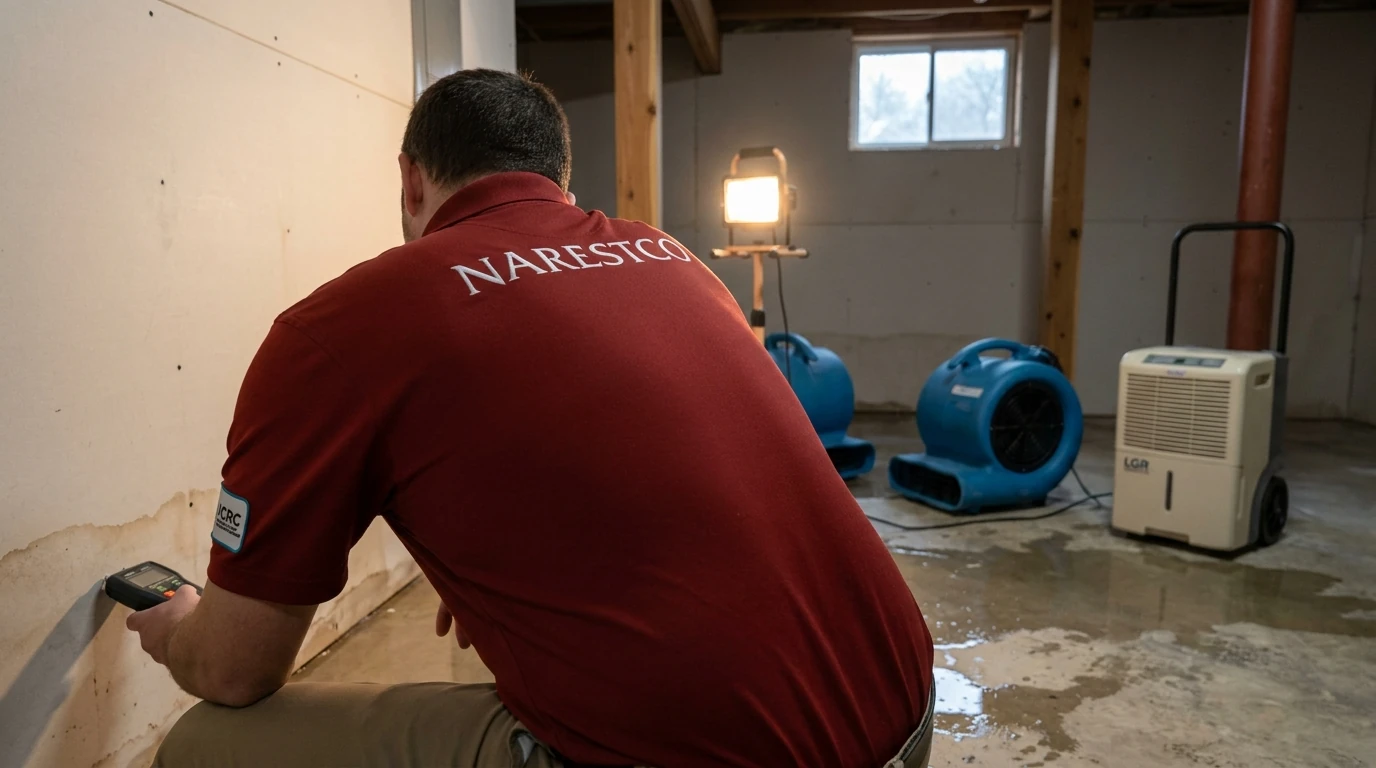
TL;DR: When your Bellevue home floods, the company you call matters more than the name you recognize. Look for IICRC certification, a Washington State contractor license, 24/7 availability, and a written scope of work before any equipment hits your floor. This guide explains what those credentials mean, why Bellevue’s housing stock creates specific flood risks, and how to evaluate any restoration company on verifiable facts, not marketing claims.
You just found standing water in your Somerset basement or a flooded unit in a Factoria townhome, and now you’re searching for someone to call. The problem isn’t finding companies, it’s knowing which ones can actually do the work correctly, document it for your insurer, and get your home dry before mold sets in. This guide walks you through the credentials, process, and local factors that separate a qualified flood restoration company from one that shows up with a few fans and a dehumidifier.
What certifications should a flood restoration company in Bellevue actually have?
The most important credential is IICRC certification, specifically the Water Damage Restoration Technician (WRT) or Applied Structural Drying (ASD) designation. The IICRC (Institute of Inspection, Cleaning and Restoration Certification) sets the S500 Standard for Professional Water Damage Restoration, which defines how moisture readings are taken, how drying goals are set, and when a structure is genuinely dry. A company without IICRC-certified technicians is guessing at drying, not following a standard.
Beyond IICRC, check for:
- Washington State contractor license, any company doing structural repairs (removing drywall, replacing flooring, rebuilding framing) must hold a current WA State Department of Labor and Industries General Contractor Certificate of Registration. You can verify any license number at lni.wa.gov.
- Lead-Safe Certified Firm, Bellevue has homes built before 1978, particularly in older West Bellevue and Lake Hills neighborhoods. Disturbing painted surfaces during flood remediation in pre-1978 homes requires EPA Lead-Safe certification under the EPA’s Renovation, Repair and Painting Rule.
- BBB Accreditation, not a technical credential, but a signal of complaint resolution history.
National Restoration Construction holds IICRC certification, EPA certification, Lead-Safe Certified Firm status, and WA contractor license NATIORC792M6. Those are verifiable facts, not marketing language.
What does flood damage restoration in Bellevue actually involve?
Flood restoration is a multi-phase process. A qualified company follows these steps in order, skipping any of them creates problems that show up weeks later as mold or structural failure.
1. Emergency water extraction (within hours) Standing water is removed using truck-mounted or portable extraction units. The longer water sits, the deeper it wicks into subfloor, framing, and insulation. IICRC S500 classifies water by contamination level: Category 1 (clean supply line), Category 2 (gray water, like a dishwasher overflow), or Category 3 (black water, including any flood water that contacted soil or sewage). Category 3 water, which includes most true flood events, requires full PPE and different disposal protocols.
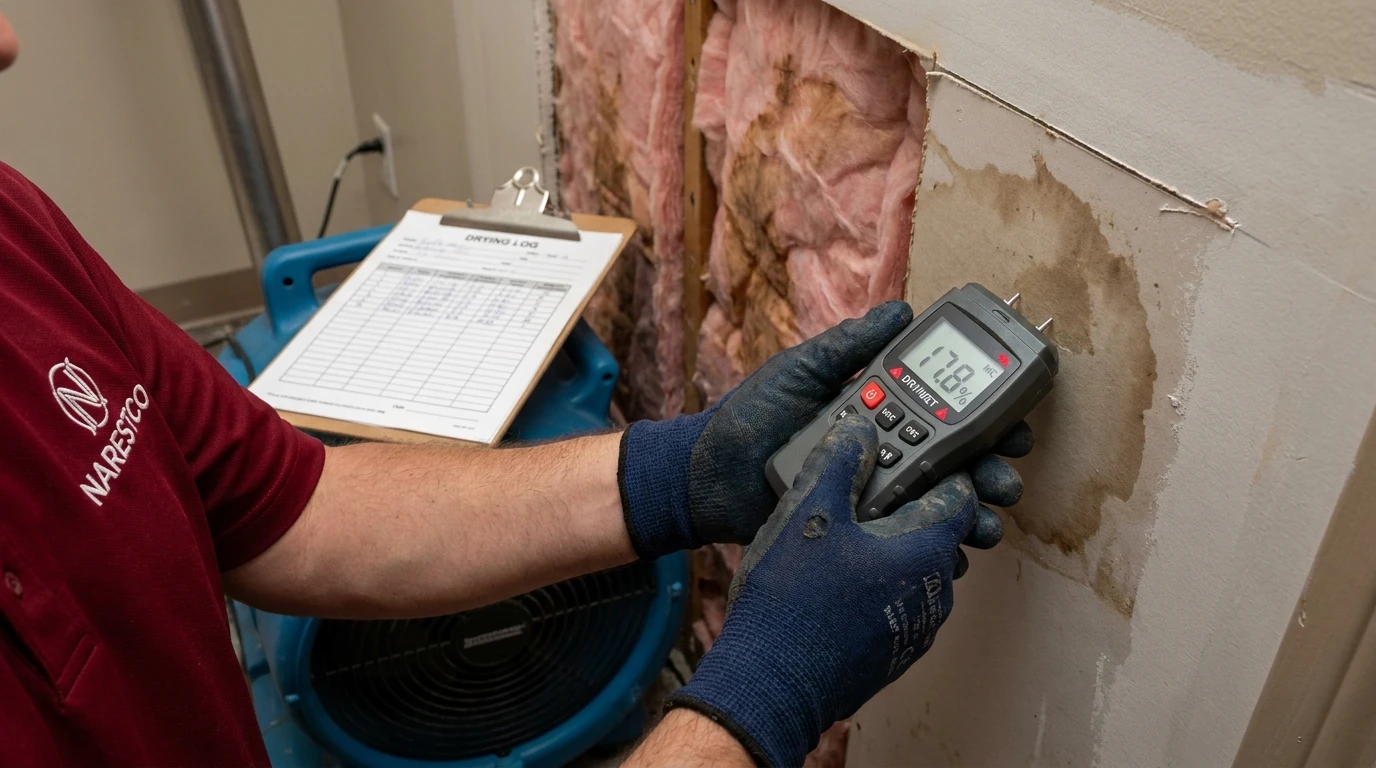
2. Structural drying with documentation This is where certification matters most. Technicians place LGR (Low Grain Refrigerant) dehumidifiers and high-velocity air movers in a calculated pattern based on the affected square footage and material types. Moisture readings are taken daily using a calibrated pin or pinless meter and logged. The goal is to reach the material’s dry standard, typically below 16% moisture content in wood framing, before any reconstruction begins.
In Bellevue’s newer townhome and condo developments near Crossroads and Newport Shores, HOA documents often require post-remediation air clearance testing before walls are closed. Ask your restoration company if they document drying logs in a format your HOA and insurer will accept.
3. Demolition of unsalvageable materials Wet drywall, insulation, and flooring that cannot be dried in place must come out. A qualified company will tell you what needs to go and why, with moisture readings to back it up. Be cautious of any company that pulls materials without showing you the readings, or conversely, one that tells you everything can be saved when readings say otherwise.
4. Antimicrobial treatment After drying, affected cavities are treated with an EPA-registered antimicrobial agent to inhibit mold growth. Mold can begin colonizing within 24-48 hours on wet organic material, see our post on how quickly mold grows after water damage for what that timeline looks like in practice.
5. Reconstruction Once the structure passes a final moisture check, rebuild begins: drywall, insulation, flooring, paint. A licensed general contractor handles this phase. Having one company handle both remediation and reconstruction simplifies the insurance claim and eliminates the coordination gap where damage can fall through.
Why does Bellevue specifically create flood risk?
Bellevue’s geography and housing stock create flood patterns that differ from the rest of the Eastside.
Elevation and drainage at Somerset and higher neighborhoods. Somerset, Cougar Mountain, and similar elevated areas shed water fast during heavy rain. That runoff concentrates at the base of slopes, pushing into foundations and window wells of lower-elevation homes. Finished basements in these areas are particularly vulnerable to hydrostatic pressure intrusion, water pushing through the foundation wall rather than coming in through a drain.
HOA-heavy condo and townhome developments. Crossroads and Factoria have dense townhome and condo inventory where a single unit’s plumbing failure can affect multiple units. HOA bylaws in these developments frequently require post-remediation air clearance testing, an industrial hygienist takes air samples after mold remediation to confirm spore counts are below outdoor ambient levels before the restoration company closes walls. Make sure the company you hire understands this requirement and can coordinate it.
Mercer Slough and low-lying areas. Properties near Mercer Slough and the wetland corridors along the I-90 corridor sit in areas with high groundwater. During extended rain events, common in Puget Sound’s wet season, groundwater can rise enough to flood crawl spaces and slab-on-grade structures even without a direct plumbing failure.
Tech-sector expectations around claim speed. Bellevue’s demographics skew toward homeowners who expect fast, documented, digital-friendly communication. A qualified restoration company should be able to provide daily moisture logs, photo documentation, and a written scope of work that your insurer’s adjuster can review without a site visit.
What questions should you ask before hiring a flood restoration company?
Before you authorize any work, ask these five questions. A qualified company answers all of them without hesitation.
-
Are your technicians IICRC-certified? Ask for the certification number or the technician’s name so you can verify at iicrc.org. “We follow IICRC standards” is not the same as holding the certification.
-
What is your Washington State contractor license number? Verify it at lni.wa.gov before any structural work begins. An unlicensed contractor doing demo and rebuild creates liability for you as the homeowner.
-
Will you provide daily moisture logs? Your insurer will want documentation that drying was completed to standard. If a company can’t produce logs, your claim may be disputed.
-
Do you handle both mitigation and reconstruction? Companies that only do mitigation hand you off to a general contractor for rebuild. That handoff creates gaps, in scheduling, in documentation, and sometimes in scope. A single company holding both licenses simplifies the process.
-
Are you available 24/7? Flood damage doesn’t happen during business hours. Extraction within the first few hours dramatically reduces total damage, and total claim cost. Confirm they can dispatch tonight, not tomorrow morning.
What to do in the next hour if your Bellevue home is flooding
Stop the source first. If the flood is from a burst pipe or appliance failure, shut off the main water supply. If it’s from storm-driven intrusion, that’s not controllable, focus on extraction. For a step-by-step checklist on the immediate response, see our burst pipe emergency checklist and what to do in the first 24 hours after water damage.
Then call a certified restoration company, not a cleaning service, not a general handyman. Flood water, especially Category 2 or 3, requires proper extraction equipment, moisture monitoring, and documented drying to meet IICRC S500. Anything less risks a mold problem in 48-72 hours and a disputed insurance claim weeks later.
National Restoration Construction responds 24/7 across Bellevue and the Eastside. Call (206) 883-0333 to reach a technician directly, not a call center.
About National Restoration Construction
National Restoration Construction is an IICRC-certified, EPA-certified, Lead-Safe Certified restoration and general contracting firm serving Bellevue, Federal Way, Seattle, and surrounding Western Washington communities since 2004 (WA contractor license NATIORC792M6). Their crews handle water and flood damage, mold remediation, fire and smoke restoration, and full reconstruction under one license, eliminating the mitigation-to-rebuild handoff gap. Available 24/7 at (206) 883-0333.