TL;DR: Fire damage restoration costs between $3 and $8 per square foot for minor smoke damage, $15 to $50 per square foot for major structural damage, and $75 or more per square foot when a home is a near-total loss. The spread is wide because fire damage is never uniform, the same 2,000-square-foot house can have three different damage tiers in three different rooms, each priced differently.
If you’re trying to figure out what your fire damage will actually cost to fix, the per-square-foot number is the fastest way to ballpark it. Your adjuster will eventually produce a line-item Xactimate estimate, but before that call happens, knowing which damage tier your home falls into tells you whether you’re looking at a $12,000 cleanup or a $180,000 rebuild.
What damage tier does your home fall into?
Most fire-damaged homes fall into one of three tiers, and the tier determines the per-square-foot cost range more than any other single factor.
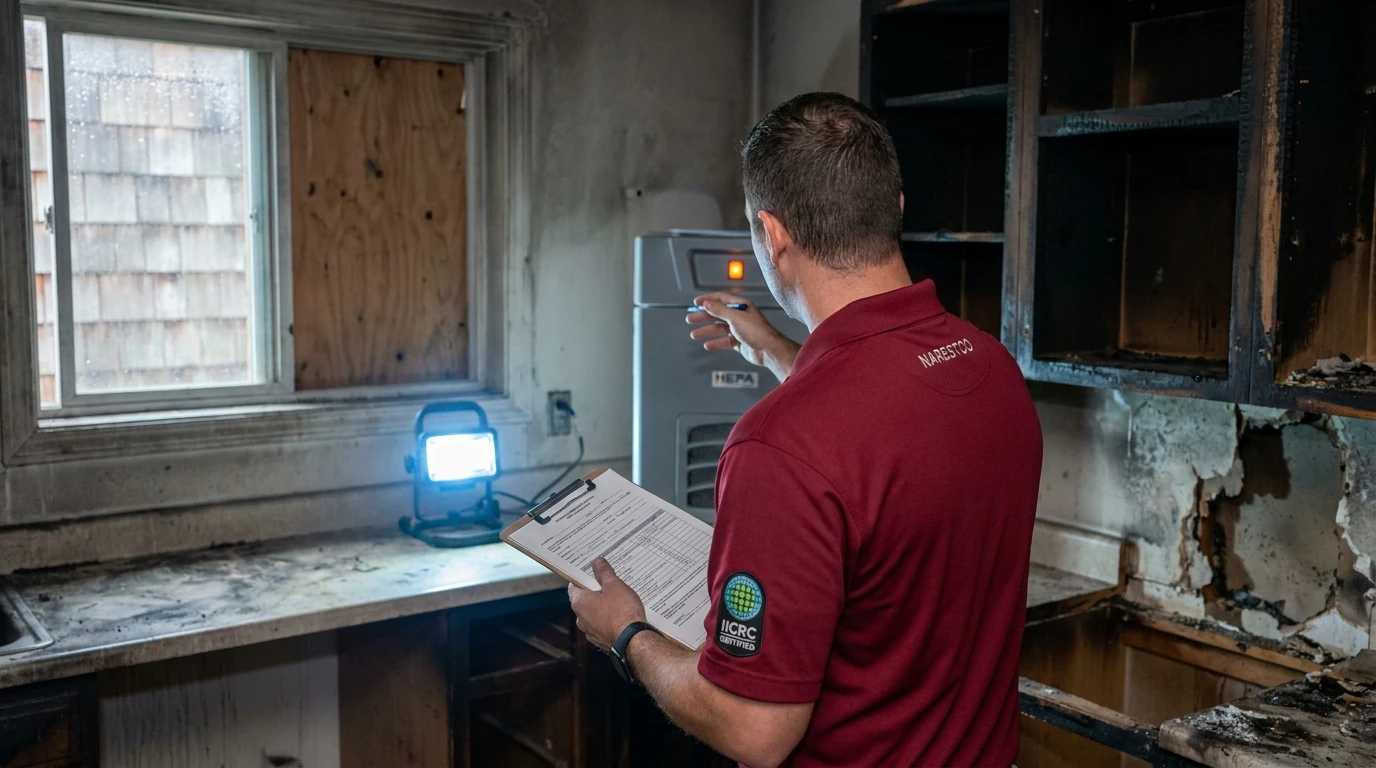
Tier 1, Minor smoke and soot ($3 to $8 per square foot): The fire was contained to one room or one appliance. The rest of the home has smoke odor and soot deposits on surfaces, but no structural damage. Restoration involves HEPA vacuuming, chemical sponge wiping, ozone or hydroxyl odor treatment, and repainting affected surfaces. A 1,500-square-foot home with Tier 1 damage might cost $6,000 to $12,000 total.
Tier 2, Moderate to major structural damage ($15 to $50 per square foot): The fire burned through drywall, flooring, cabinetry, or framing in one or more rooms. Structural members may need sistering or replacement. Contents are heavily damaged. Restoration involves full demolition of burned materials, odor treatment of the structure itself, and partial reconstruction. A 2,000-square-foot home with Tier 2 damage across 40% of the structure could run $60,000 to $120,000.
Tier 3, Near-total or total loss ($75 per square foot and up): The fire burned through the roof, compromised load-bearing walls, or destroyed the majority of the living space. In some cases the structure must be torn down to the foundation. At $75 per square foot, a 2,000-square-foot home costs $150,000 or more, and that number climbs fast in high-labor-cost markets.
What drives the per-square-foot cost up or down?
The tier gives you a range, but several variables push the final number toward the high or low end.
Smoke penetration depth. Smoke doesn’t stop at the surface. In a house with forced-air HVAC, smoke gets pulled into ductwork, insulation, and wall cavities. Deodorizing a surface is cheap. Deodorizing a wall cavity means opening drywall, treating the framing, and repatching. That adds $4 to $12 per square foot to any affected area.
Soot type. Dry soot from fast-burning fires (paper, wood) wipes off surfaces relatively easily. Wet soot from slow-burning, protein-based fires (cooking fires, upholstered furniture) bonds to surfaces and requires chemical cleaning agents and more labor time. Protein fire cleanup typically costs 20 to 40% more per square foot than dry-soot cleanup.
Water damage from suppression. Firefighters use roughly 50 to 80 gallons of water per minute. A 20-minute suppression effort can put 1,000 to 1,600 gallons into a structure. That water has to be extracted and dried, adding water damage restoration costs on top of fire costs. Expect to add $3 to $8 per square foot to any area that received suppression water.
Structural materials involved. Replacing drywall runs $2 to $4 per square foot. Replacing fire-damaged hardwood flooring runs $8 to $15 per square foot. Replacing burned roof sheathing and framing runs $10 to $25 per square foot depending on the span. The material mix in your home shifts the reconstruction cost significantly.
Hazardous materials. Homes built before 1980 often contain asbestos in drywall joint compound, floor tiles, or pipe insulation. Fire disturbs these materials, and any reconstruction work requires licensed abatement before framing work begins. Asbestos abatement adds $5 to $15 per square foot to affected areas.
How do restoration contractors actually calculate a fire damage estimate?
Most licensed restoration contractors use Xactimate, an industry-standard estimating platform that prices each line item (demo, cleaning, reconstruction) by local labor and material rates. The per-square-foot figure you see in an estimate is the output of dozens of line items, not a single multiplier applied to the whole house.
Here’s what a contractor is actually measuring during a fire damage assessment:
- Affected square footage by damage tier. They walk the structure and map which rooms are Tier 1, Tier 2, or Tier 3. A kitchen might be Tier 3 while the adjacent living room is Tier 1.
- Linear feet of affected walls and ceilings. Smoke and soot cleaning is priced per square foot of surface area, not floor area. A room with 9-foot ceilings has more surface area than the same room with 8-foot ceilings.
- Contents inventory. Damaged personal property is itemized separately. Contents cleaning and pack-out is typically priced per item or per cubic foot, not per square foot of floor space.
- Structural scope. Any framing, sheathing, or load-bearing element that needs replacement gets individually measured and priced.
- Specialty line items. Duct cleaning, odor treatment, asbestos testing, and temporary board-up are added as separate line items.
When you receive a written scope from a contractor, ask them to break out the mitigation (cleanup) cost from the reconstruction cost. These are two separate phases, often handled by the same company but billed differently to your insurer.
What does insurance typically cover?
Most standard homeowners policies (HO-3 form) cover fire damage to the structure and personal property, minus your deductible. The insurer pays to restore the home to its pre-loss condition, not to upgrade it. If your 1985 kitchen had laminate countertops, they’ll pay for laminate replacement, not quartz.
Key coverage points to confirm with your adjuster:
- ALE (Additional Living Expenses): Covers hotel and meals while your home is uninhabitable. Confirm the daily limit and total cap.
- Code upgrade coverage: If reconstruction requires bringing electrical or plumbing up to current code, standard policies often don’t cover the upgrade cost. An “ordinance or law” endorsement covers this gap, worth checking if your home is more than 20 years old.
- Contents replacement cost vs. actual cash value: Replacement cost pays what it costs to buy new. Actual cash value deducts depreciation. The difference on a full contents loss can be tens of thousands of dollars.
For a deeper look at total fire damage costs beyond the per-square-foot breakdown, see our fire damage restoration cost guide.
If you need a written scope and per-square-foot estimate for your specific loss, National Restoration Construction’s fire damage team can assess the damage and provide documentation your adjuster can work from directly. Request a fire damage estimate or call (206) 883-0333.
About National Restoration Construction
National Restoration Construction is an IICRC-certified restoration and reconstruction company serving the greater Puget Sound region since 2004 (WA contractor license NATIORC792M6). Their crews handle fire damage mitigation, smoke and soot removal, structural reconstruction, and full general contracting for residential and commercial losses across Federal Way, Seattle, Tacoma, Bellevue, and surrounding King and Pierce County communities. NARESTCO is also EPA Lead-Safe Certified and BBB Accredited.