
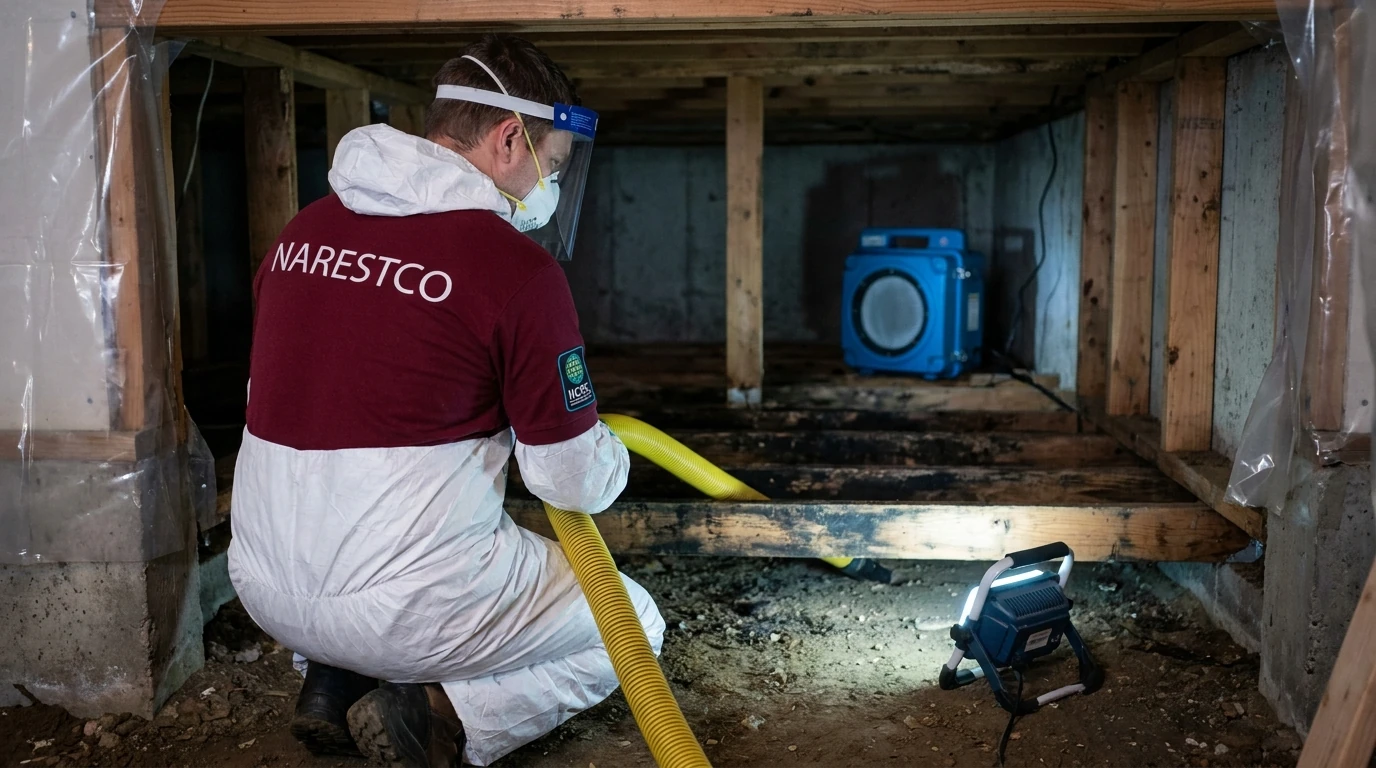
TL;DR: Mold remediation in Seattle typically costs $1,500 to $6,000 for a contained area like a bathroom or basement wall. Crawl spaces run $2,000–$8,000. Attics with widespread growth can reach $10,000 or more. What drives the price: square footage of affected material, the type of surface (drywall vs. framing vs. concrete), containment complexity, and whether post-remediation air clearance testing is required. Most homeowners insurance excludes mold unless it resulted from a covered water event.
If you just noticed dark patches spreading across your basement ceiling in Ballard or found fuzzy growth in a Queen Anne craftsman crawl space, you’re probably wondering what this is going to cost before you call anyone. That’s a fair question. Seattle’s pre-1950 housing stock, sustained Puget Sound rainfall, and chronically damp crawl spaces make mold one of the most common remediation calls in the region. The numbers below reflect what jobs actually cost in the Seattle market, not national averages that ignore Pacific Northwest labor and material realities.
How much does mold remediation cost per square foot in Seattle?
Mold remediation in Seattle costs $15–$30 per square foot of affected material, with the total job price depending on how much surface area needs treatment, removal, or replacement. A 50-square-foot bathroom with surface mold on drywall typically runs $1,500–$2,500. A 200-square-foot basement wall with mold penetrating into the framing can reach $4,000–$7,000.
Those per-square-foot figures cover labor, containment setup, HEPA air filtration, antimicrobial treatment, and disposal. They do not include post-remediation clearance testing (typically $300–$600 separately) or reconstruction to replace removed drywall and insulation. Reconstruction adds $1,500–$5,000 depending on the scope.
Seattle labor rates run 15–25% above national averages, which is why local quotes will be higher than what you see on national cost-estimator sites. An IICRC-certified crew following the S520 Standard for Professional Mold Remediation also takes longer than a cut-rate operation that sprays bleach and calls it done, and the S520 process is what your insurer and a future home inspector will expect to see documented.
What are the biggest factors that drive mold remediation cost?
Five factors determine most of the price variation on Seattle mold jobs: location in the home, surface type, contamination depth, containment requirements, and whether the moisture source is fixed.
Location in the home matters more than most homeowners expect:
- Bathroom or laundry room (contained, accessible): $1,500–$3,500
- Basement walls and floor joists: $2,500–$6,000
- Crawl space (limited access, often requires encapsulation): $3,000–$10,000
- Attic (large surface area, structural framing involved): $4,000–$12,000
- HVAC system contamination: $2,000–$6,000 depending on duct extent
Surface type changes the remediation method. Mold on non-porous surfaces (concrete, tile, glass) can be cleaned and treated. Mold on porous materials (drywall, insulation, wood framing) usually requires removal and replacement, you cannot clean mold out of drywall paper. Structural framing that is salvageable gets HEPA-vacuumed, wire-brushed, and treated with an EPA-registered antimicrobial. Framing that is too far gone gets removed.
Contamination depth is assessed during inspection. Surface mold (Category 1 contamination) on a painted wall is a different job than mold that has colonized behind the vapor barrier in a 1970s Wallingford rambler. Depth assessment requires a moisture meter reading and sometimes an air sample or surface swab to identify species and concentration.
Containment requirements scale with the job. A small bathroom gets a basic poly-sheeting containment and negative air pressure machine. A whole-attic remediation requires full critical barriers, a decontamination chamber, and continuous HEPA air scrubbing throughout the job. More containment means more labor hours and more equipment rental.
The moisture source has to be fixed before remediation starts, or mold returns within weeks. If the source is an active roof leak, a failed crawl space vapor barrier, or a plumbing line dripping inside a wall, that repair cost is separate from the remediation cost. A reputable contractor will not start remediation until the source is addressed.
How much does crawl space mold remediation cost in Seattle?
Crawl space mold remediation in Seattle costs $3,000–$10,000, and it is the most common high-cost mold job in the region. Seattle’s pre-1950 craftsmen and Tudors, common in neighborhoods like Greenwood, Magnolia, and Beacon Hill, were built without modern vapor barriers, and decades of Puget Sound moisture accumulation creates ideal conditions for mold growth on the subfloor joists.
A standard crawl space job includes: HEPA vacuuming of affected framing, antimicrobial treatment of joists and rim joists, removal of contaminated insulation, and installation of a new 20-mil poly vapor barrier. If the crawl space has standing water or significant drainage issues, that work is additional.
Crawl space encapsulation, a full sealed-liner system with a dehumidifier, runs $5,000–$15,000 but is often recommended after remediation to prevent recurrence. Some contractors bundle a partial encapsulation into the remediation price; ask specifically what is included.
How much does attic mold remediation cost in Seattle?
Attic mold remediation in Seattle costs $4,000–$12,000 for most residential jobs, with the wide range driven by attic size and the extent of sheathing involvement. Attic mold in Seattle is almost always caused by one of three things: inadequate ventilation, a bathroom exhaust fan venting into the attic instead of outside, or a roof leak. The mold grows on the OSB or plywood roof sheathing.
If the sheathing is structurally sound, it can be remediated in place: HEPA vacuum, wire brush or dry ice blast, antimicrobial treatment, and encapsulant coating. If the sheathing is delaminating or soft, it needs replacement, which means roofing work, not just remediation. Attic jobs also require full containment and a decontamination chamber because disturbing attic mold releases significant spore loads.
For a 1,200-square-foot attic with moderate sheathing contamination and no structural replacement needed, expect $5,000–$8,000 in the Seattle market.
Does insurance cover mold remediation in Seattle?
Homeowners insurance covers mold remediation only when the mold resulted directly from a covered peril, typically a sudden, accidental water event like a burst pipe or appliance failure. It does not cover mold from slow leaks, chronic moisture, flooding, or deferred maintenance.
Here is how the coverage question usually plays out:
- Burst pipe caused the moisture, mold developed within days: Usually covered under the water damage claim. The adjuster may require documentation that remediation followed IICRC S520 protocols.
- Roof leak caused the moisture: Covered if the roof damage itself was covered (storm event). Not covered if the leak was from wear and deferred maintenance.
- Crawl space moisture over years: Almost never covered. This is considered a maintenance issue.
- Flooding: Standard homeowners policies exclude flood. Flood insurance (NFIP or private) may cover mold that resulted from the flood event, but coverage limits and documentation requirements vary.
Washington State does not mandate mold coverage in standard homeowners policies, so your coverage depends entirely on your policy language. If you have an active water damage claim, ask your adjuster specifically whether mold remediation is included in the scope before signing anything. Get the scope of work in writing from the remediation contractor so the adjuster can review it.
For mold jobs that are not covered by insurance, most restoration contractors offer financing or can work with a public adjuster if there is a legitimate coverage dispute.
What should you do if you find mold in your Seattle home?
Stop the moisture source first, then call for a mold inspection before disturbing anything. Disturbing mold growth without proper containment spreads spores throughout the home and can turn a $2,000 bathroom job into a $10,000 whole-house problem.
Here is the sequence that protects both your health and your wallet:
- Fix the water source (or confirm it is fixed). No remediation contractor following IICRC S520 will start work with an active leak.
- Get a mold inspection and air quality test from a qualified inspector. This gives you a written scope of contamination before you get remediation bids. It also creates documentation for an insurance claim.
- Get two or three written bids that specify the remediation protocol, containment plan, and whether post-remediation clearance testing is included.
- Confirm the contractor’s credentials: IICRC certification (look for the Applied Microbial Remediation Technician credential, or AMRT), Washington State contractor license, and liability insurance.
- Do not accept a bid that skips clearance testing. Post-remediation air sampling confirms the job is done. Without it, you have no documentation that the mold is gone, which matters for resale and insurance.
If the affected area is under 10 square feet and limited to a non-porous surface, the EPA says a careful DIY cleanup is possible. Anything larger, anything involving structural materials, or any situation where a health-compromised person lives in the home warrants professional remediation.
National Restoration Construction handles mold inspections and full remediation across Seattle, from Fremont bungalows to West Seattle townhomes. If you want a written scope and cost estimate before committing to anything, request a mold assessment or call (206) 883-0333.
About National Restoration Construction
National Restoration Construction is an IICRC-certified, EPA-certified, and Lead-Safe Certified restoration company serving Seattle and the greater Puget Sound region since 2004 (WA license NATIORC792M6, issued by the WA State Department of Labor and Industries). Their crews handle mold remediation, water damage, fire damage, and full reconstruction across King, Pierce, and Snohomish counties. Available 24/7 at (206) 883-0333.