
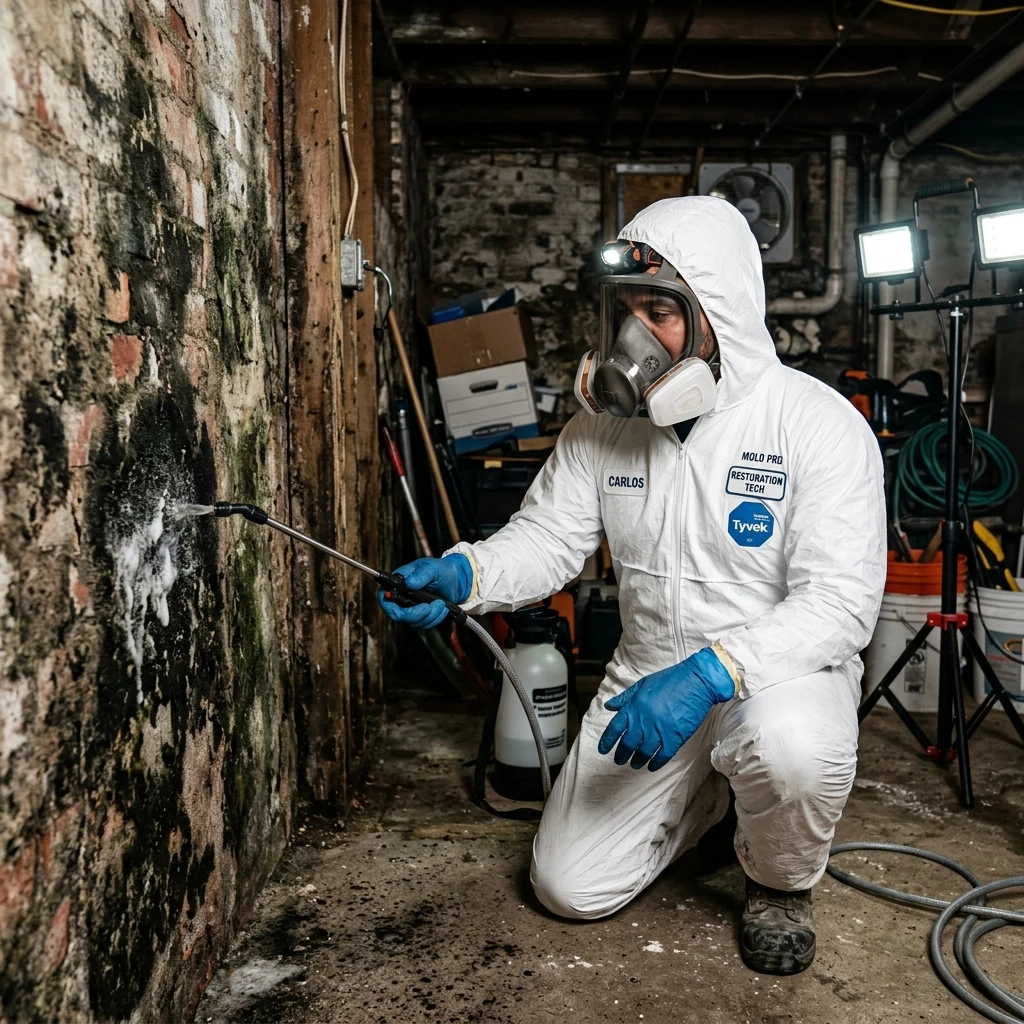
Mold Remediation in Des Moines
24/7 mold remediation in Des Moines, WA. IICRC-certified, insurance billing accepted. Call (206) 883-0333.
We work with all insurance carriers and handle the claim paperwork.
Our IICRC-certified technicians are dispatched from our Federal Way, WA headquarters and are typically on-site in Des Moines within 60 minutes of your call.
Des Moines sits along Puget Sound in a climate that rarely gets cold enough to freeze pipes hard but stays persistently damp through eight or nine months of the year. That steady marine moisture, combined with the older housing stock that lines much of the city’s hillside streets, creates exactly the conditions where mold colonies establish quietly behind walls and under subfloors long before a homeowner notices a smell. If you have found discoloration on a ceiling, a musty odor that lingers after airing out a room, or a water stain that never fully dried, a professional assessment is the right next step.
Why Des Moines Properties See Mold Issues
The geography here works against dry building envelopes. The bluff neighborhoods that step down toward the waterfront trap fog and condensation against exterior walls, and crawl spaces in homes built before the 1980s were often vented in ways that made sense for older construction standards but pull humid outside air directly under the living space. Fiberglass batt insulation in those crawl spaces holds moisture against floor joists, and once wood-rot fungi or black mold get a foothold in that environment, they spread faster than most homeowners expect. The IICRC standard for mold remediation notes that active colonization can begin within 24 to 48 hours of a moisture event, and in a climate like western King County’s, the moisture event is often not a single dramatic leak but a slow accumulation over a wet season.
Older homes in Des Moines also frequently have original cedar or fir framing, which is naturally more resistant to rot than modern SPF lumber but is not immune, especially when vapor barriers are absent or degraded. Homes with original single-pane windows and minimal wall insulation experience significant thermal bridging, which drives condensation inside wall cavities every winter.
Our Mold Remediation Process in Des Moines
Every project begins with a visual inspection and moisture mapping using thermal imaging and calibrated moisture meters. We identify the moisture source first, because remediation without source correction is a temporary fix. Once the scope is established, we set up physical containment with negative air pressure and HEPA-filtered air scrubbers to prevent spores from migrating to unaffected areas of the home during work.
Affected porous materials, typically drywall, insulation, and in some cases framing, are removed and bagged for disposal following Washington State guidelines. Non-porous surfaces are cleaned with EPA-registered antimicrobial agents. After cleaning, the area is dried to baseline moisture levels before any reconstruction begins. Our team holds IICRC certification and operates as a Lead-Safe Certified Firm, which matters in Des Moines where a meaningful portion of the housing stock predates 1978 and may contain lead-based paint on surfaces disturbed during remediation.
Response Time to Des Moines
National Restoration Construction is based in Federal Way, which puts Des Moines well within a short drive. From our Federal Way office, reaching the Des Moines Marina area or the residential streets near Highline Community College typically takes under 20 minutes depending on traffic on Pacific Highway South or Marine View Drive. We schedule assessments promptly and work to get eyes on a moisture problem before conditions worsen.
Des Moines Insurance Coordination
Mold claims in Washington can be complicated by the distinction insurers draw between sudden-and-accidental water damage and long-term seepage. We document the affected area thoroughly with photographs, moisture readings, and written scope notes, which gives your adjuster the information needed to evaluate the claim accurately. We work with most major carriers and can communicate directly with your insurance representative throughout the project so you are not caught translating between a contractor and an adjuster.
Local Note
Homes on the steeper streets between the waterfront and the plateau in Des Moines often have daylight basements or partial below-grade spaces that were finished in the 1970s and 1980s using paper-faced drywall directly against concrete or CMU block walls. That assembly has no drainage plane and no vapor barrier, and it is one of the most reliable places to find mold in this part of King County. If your home was built or remodeled in that era and has a finished lower level, it is worth having the wall cavities assessed even if there is no visible discoloration, because the paper facing on the backside of the drywall can be fully colonized while the painted surface looks clean.
If you are seeing signs of mold growth in your Des Moines home or have recently had a water intrusion event, call National Restoration Construction at (206) 883-0333. We will assess the situation honestly, explain what the remediation scope involves, and handle the work from containment through reconstruction so you are dealing with one point of contact, not a chain of subcontractors.
Serving Des Moines from our Federal Way headquarters — ★ 5.0 · 66 Google reviews
“National Restoration Construction were great to work with. Responsive, available, efficient and polite. Great quality work.” — Lauren, September 2026Read our reviews on Google →
Mold Remediation in Des Moines: Service Coverage
Frequently Asked Questions
How fast can you arrive for mold remediation in Des Moines?
How quickly can National Restoration Construction reach Des Moines for a mold assessment?
Does the older housing stock common in Des Moines affect how mold remediation is scoped?
Are crawl spaces in Des Moines homes a common source of mold problems?
Will my homeowner's insurance cover mold remediation in Des Moines?
What does mold containment actually involve during a remediation project?
Mold Remediation response in Des Moines
Most Des Moines calls see a technician on-site within 60 minutes from our Federal Way headquarters.