
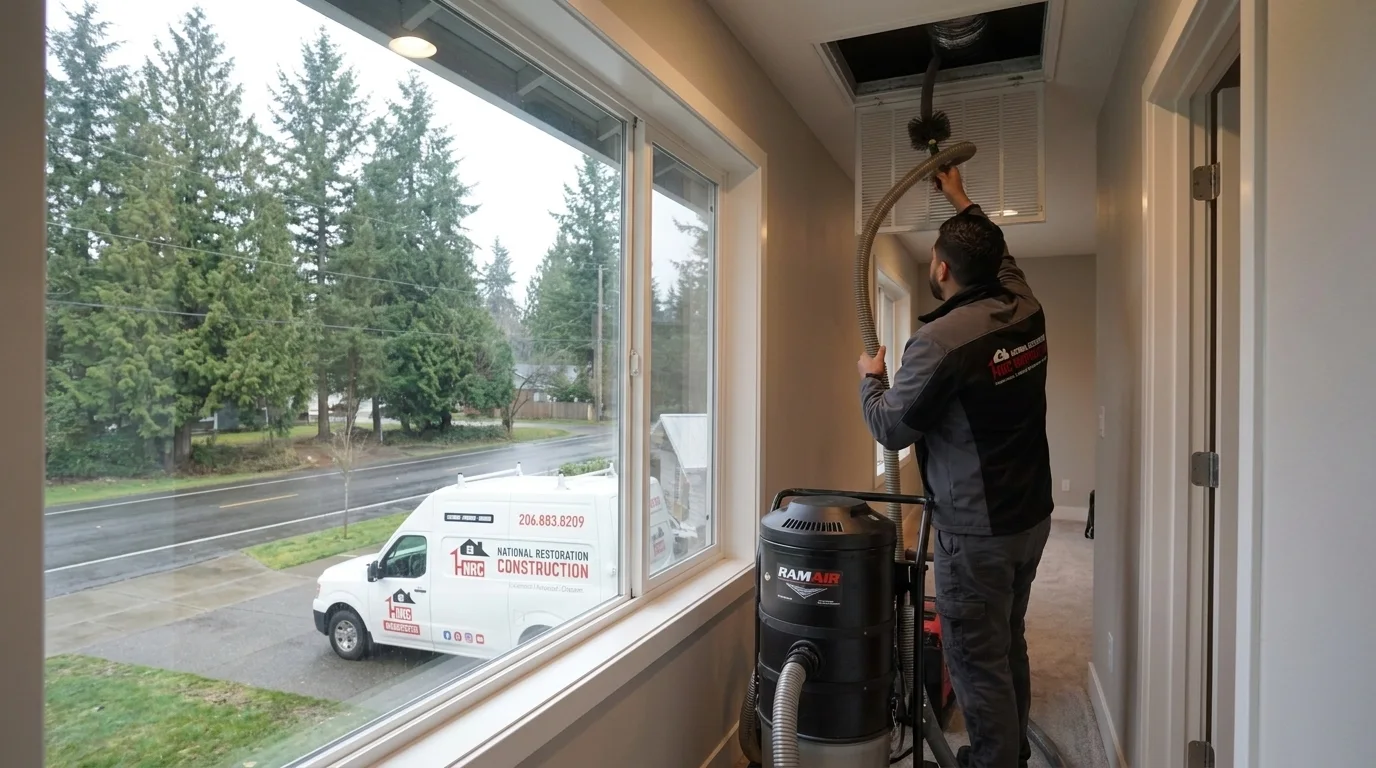
Air Duct Cleaning in Federal Way
24/7 air duct cleaning in Federal Way and surrounding areas. IICRC-certified, insurance billing accepted. Call (206) 883-0333.
We work with all insurance carriers and handle the claim paperwork.
What Air Duct Cleaning actually involves
A full HVAC duct cleaning isn’t a shop-vac pass through the registers. Technicians connect a negative-air machine to the main trunk line, seal off supply and return registers one section at a time, and use rotary brushes or air whips to dislodge dust, pet dander, drywall debris, and insulation fibers built up along the duct walls. The debris gets pulled into a HEPA-filtered collection system instead of blowing back into the living space. A typical single-family home with a standard forced-air system takes two to four hours, depending on the number of supply runs, whether the return side has a filter grille or a dedicated plenum, and how long it’s been since the ductwork was last serviced, sometimes never, in homes with original 1980s-1990s HVAC installs. Dryer vent cleaning is scoped separately since it runs through a single rigid or semi-rigid line to an exterior termination and uses different brush diameters and airflow testing to confirm full clearance.
Our process
- System inspection - we check duct material (sheet metal, flex, or fiberboard), locate access points, and run a camera scope through a sample section to document existing buildup before any work starts.
- Negative pressure setup - the main trunk is connected to a HEPA-filtered vacuum unit that holds the entire duct system under negative pressure so dislodged debris can’t escape into the house through gaps or loose joints.
- Agitation and extraction - each branch line gets mechanically agitated with rotating brushes or compressed-air whips while the vacuum pulls contaminants out register by register.
- Sanitization pass (when requested or when microbial growth is present) - an EPA-registered antimicrobial is applied to interior duct surfaces to address odor-causing residue, not as a substitute for mold remediation if active growth is found.
- Dryer vent and final verification - the dryer line is brushed and air-tested separately, registers are reset, and we do a final airflow check at several supply vents to confirm nothing is still restricted.
What separates a good duct cleaning response from a bad one
The biggest shortcut in this trade is skipping negative pressure and just vacuuming the registers you can reach. That knocks loose dust at the opening but leaves the bulk of it sitting fifteen feet down the trunk line, where it recirculates every time the blower kicks on. A thorough job seals the whole system before agitation starts, so nothing escapes into the house mid-cleaning. Another common miss is treating the dryer vent as an afterthought: a partially restricted dryer line is a documented fire risk, and it needs its own airflow test, not a visual glance down the duct. On the sanitization side, applying antimicrobial product over visible mold growth instead of addressing the moisture source just masks a problem that will come back. If a duct cleaning job uncovers standing moisture, disconnected flex duct, or signs of rodent activity, that gets documented and scoped separately rather than cleaned over.
What does Air Duct Cleaning cost?
Industry-typical costs vary with the size of the home, the number of supply and return runs, and whether sanitization or dryer vent service is bundled in. Most homeowners pay more for homes with crawlspace or attic ductwork that’s harder to access, and less for simpler single-story layouts with a central plenum. Every system is different, which is why National Restoration Construction provides a written scope after the initial inspection, before any cleaning begins. Air duct cleaning is a maintenance service and typically isn’t covered by homeowners insurance unless it’s tied to a covered loss, such as duct contamination from a fire or water event, in which case we document the connection for the claim.
| Scenario | Typical range |
|---|---|
| Small home, single HVAC system, no sanitization | $300 - $500 |
| Average 3-4 bedroom home, full duct cleaning | $450 - $900 |
| Larger home or multiple HVAC zones | $900 - $1,500 |
| Add-on antimicrobial sanitization | $100 - $250 |
| Dryer vent cleaning (standalone) | $100 - $200 |
| Duct cleaning following fire or water damage, with contamination documentation | $800 - $2,000+ |
Seasonal & regional considerations
Federal Way’s marine climate means homes run the heat pump or furnace heavily for much of the year and the AC or fan rarely often enough to keep dust from settling undisturbed in the ducts between seasons. Homes near wooded lots or with crawlspace returns tend to pull in more organic debris and moisture-laden air, which is worth flagging during inspection even when the visible duct interior looks clean. Fall, before heating season ramps up, and spring, after a damp winter, are the two windows where cleaning does the most good for indoor air quality.
Service area
National Restoration Construction serves Federal Way and the surrounding South King County area, including Auburn, Kent, Des Moines, and Tacoma. Our crews are IICRC and EPA certified and hold a General Contractor Certificate of Registration in Washington.
If your vents are blowing dust, your dryer’s taking longer to finish a load, or it’s just been years since anyone’s looked inside your ductwork, call (206) 883-0333 to schedule an inspection and get a written scope before any work starts.
Services We Handle
- Air Duct & HVAC Cleaning
Frequently Asked Questions
How do I know if my ducts actually need cleaning?
Does homeowners insurance cover air duct cleaning?
How long does dryer vent cleaning take compared to full duct cleaning?
Will duct cleaning get rid of mold in my HVAC system?
Can duct cleaning damage older or fragile ductwork?
Looking for the best air duct cleaning company in Federal Way?
National Restoration Construction provides licensed and insured air duct cleaning in Federal Way, WA and the surrounding area, and has served local property owners since 2004. Customers rate us 5.0 out of 5 stars across 66 Google reviews. We answer calls 24/7 — call (206) 883-0333 for immediate help.
Need Air Duct Cleaning now?
We respond 24/7 across Federal Way and surrounding WA cities.
Related Coverage
- Our Restoration Services
- Contact National Restoration Construction
- Restoration Services in Algona
- Restoration Services in Auburn
- Restoration Services in Bellevue
- Restoration Services in Bremerton
- Restoration Services in Burien
- Restoration Services in Des Moines
- Restoration Services in Edgewood
- Restoration Services in Everett
- Restoration Services in Fife
- Restoration Services in Gig Harbor
- Restoration Services in Kent
- Restoration Services in Kirkland
- Air Duct Cleaning in Des Moines
- Air Duct Cleaning in Edgewood
- Air Duct Cleaning in Everett
- Air Duct Cleaning in Fife
- Air Duct Cleaning in Gig Harbor
- Air Duct Cleaning in Kent
- Air Duct Cleaning in Kirkland
- Air Duct Cleaning in Milton
- Air Duct Cleaning in Port Orchard
- Air Duct Cleaning in Redmond
- Air Duct Cleaning in Renton
- Air Duct Cleaning in Seattle
- Air Duct Cleaning in Sumner
- Air Duct Cleaning in Tacoma
- Air Duct Cleaning in University Place