
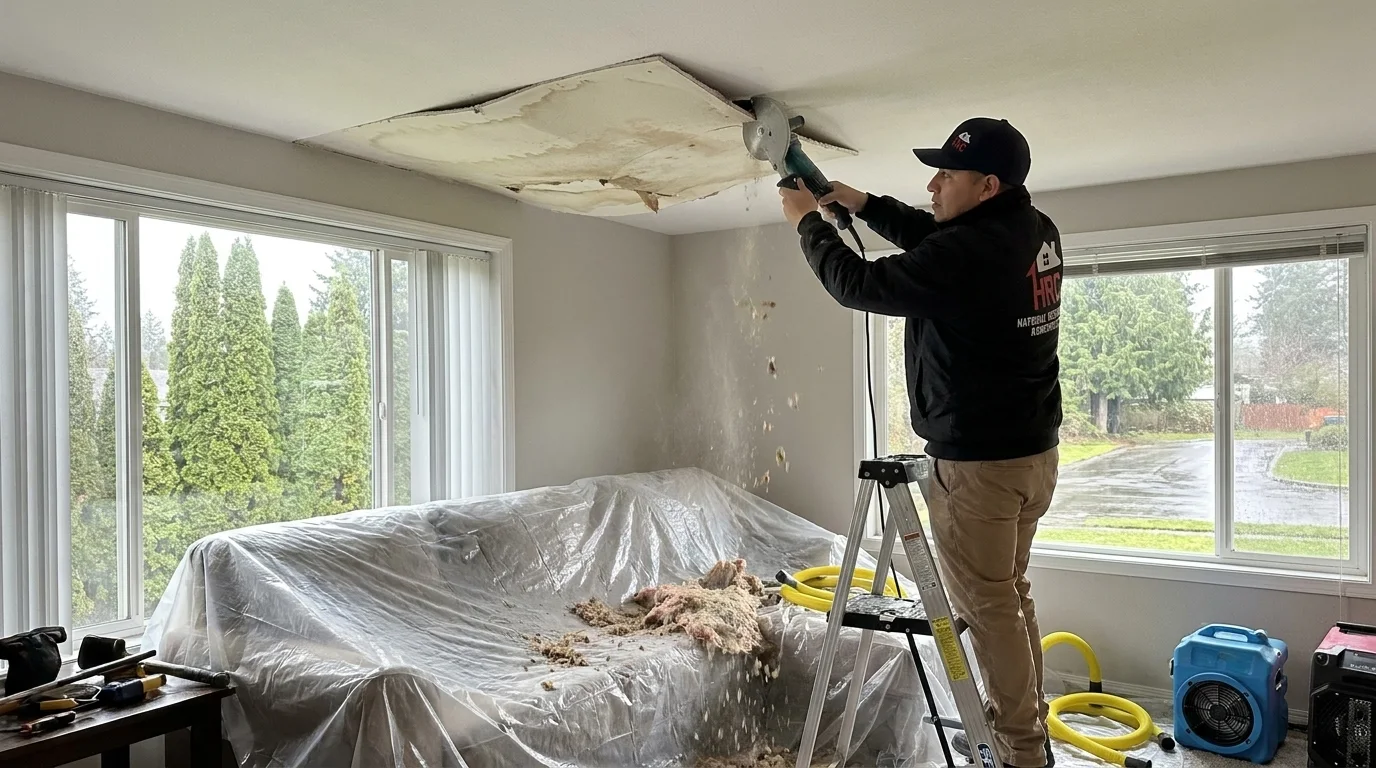
24/7 Emergency Ceiling Water Damage Repair in Federal Way
24/7 emergency ceiling water damage repair in Federal Way and surrounding areas. IICRC-certified, insurance billing accepted. Call (206) 883-0333.
We work with all insurance carriers and handle the claim paperwork.
Water coming through the ceiling? A brown ring spreading across drywall, a bubble forming overhead, or water actually dripping from a light fixture means the damage is already past the surface. Call now for emergency service before the saturated drywall lets go or the moisture reaches wiring and insulation. Ceiling water damage moves fast once paper-faced drywall absorbs water: paint blisters within hours, the board itself can sag and fail within a day or two depending on how much water is feeding it.
What Ceiling Water Damage Repair actually involves
A leaking ceiling is rarely just a ceiling problem. The water traveled from somewhere, a roof penetration, a second-floor bathroom, an ice-damaged gutter, a supply line inside a wall cavity, and by the time it shows up as a stain it has usually already wicked into insulation, framing, and sometimes the wall below. Repair work means identifying and stopping the source, mapping how far the water actually traveled with moisture meters (not just where the stain is visible), removing compromised drywall or plaster, drying the framing cavity and any adjoining insulation, and rebuilding the ceiling to match texture and paint. For older Federal Way homes with plaster-and-lath ceilings, the approach changes: plaster holds water differently than drywall and can stay saturated well after the surface looks dry, so moisture readings matter more than appearance.
Our process
- Source identification and moisture mapping. Before any material comes down, we trace the leak to its origin and use moisture meters and sometimes thermal imaging to map the full wet area, which is almost always larger than the visible stain.
- Containment of the ceiling cavity. We isolate the work area to keep water, insulation debris, and dust from spreading into the room below or adjacent spaces, particularly important when the ceiling is sagging and could release water or material without warning.
- Controlled removal versus inject-and-dry. Depending on how much the drywall or plaster has absorbed, we either remove the compromised section cleanly or, if the material is still structurally sound, dry it in place with targeted airflow and dehumidification to avoid unnecessary demolition.
- Structural drying and monitoring. Joists, trusses, and insulation behind the ceiling get dried to a dry standard, not just dried to the touch, with follow-up moisture readings logged over several days per IICRC S500 drying guidelines.
- Rebuild and refinish. New drywall or plaster repair, texture matching, priming, and paint, brought back to the original ceiling profile so the repair isn’t visible from the room below.
What separates a good ceiling water damage response from a bad one
The most common mistake is treating the visible stain as the whole problem. A crew that paints over a stain without checking moisture content above it is setting up a mold claim six weeks later. Insurance adjusters look for documented moisture readings at multiple points, not just at the stain, and they look for photos of what was actually behind the drywall before it was replaced. Another frequent miss is ignoring insulation: wet fiberglass or cellulose above a ceiling loses R-value and stays a moisture reservoir even after the drywall is replaced, so it needs to come out, not just be left to dry on its own. On older homes, disturbing plaster or textured ceiling material without checking for lead paint is a real liability, which is part of why we work as a Lead-Safe Certified Firm on any ceiling built before 1978.
What does Ceiling Water Damage Repair cost?
Costs vary widely depending on how much of the ceiling is affected, whether insulation and framing need replacement, and whether the finish is flat drywall, textured drywall, or plaster. Every loss gets a written scope before any work begins, so you know exactly what’s being repaired and why. Homeowners insurance typically covers ceiling water damage when the source is sudden and accidental, like a burst pipe or failed appliance supply line, but it generally excludes damage from long-term neglected leaks or deferred roof maintenance.
| Scenario | Typical range |
|---|---|
| Small stain, drywall intact, no removal needed | $350 - $900 |
| Single ceiling section, drywall cut-out and patch | $800 - $2,200 |
| Full room ceiling with insulation replacement | $2,000 - $5,500 |
| Plaster ceiling repair (older home) | $1,800 - $6,000 |
| Ceiling damage with structural framing repair | $4,000 - $10,000+ |
Seasonal & regional considerations
Federal Way’s wet season runs heavy from fall through spring, and most ceiling leaks we see trace back to roof penetrations, clogged gutters, or ice-related backups during the occasional hard freeze rather than true ice damming, which is less common this far south. Second-floor bathroom and laundry supply lines are the other steady source year-round, since older homes in the area often have original copper or galvanized plumbing reaching the age where pinhole leaks become more likely.
Service area
We repair ceiling water damage throughout Federal Way and the surrounding South King County area, including homes in Auburn, Kent, Des Moines, and Tacoma, where the mix of older plaster construction and newer drywall builds means no two ceiling repairs look quite the same.
If water is actively coming through your ceiling, don’t wait on the stain to spread. Schedule your ceiling moisture assessment now and we’ll trace the source, stop further damage, and give you a written repair scope before anything is torn out.
Frequently Asked Questions
Does homeowners insurance cover ceiling water damage repair?
How do I know if my ceiling leak is serious enough to call someone right away?
Will you have to tear out my whole ceiling, or can it be dried in place?
Why does the stain look small but the repair estimate cover a much bigger area?
Do I need to worry about lead paint if my ceiling was built before 1978?
Watch: Ceiling Water Damage Repair in Federal Way
Looking for the best ceiling water damage repair company in Federal Way?
National Restoration Construction provides licensed and insured ceiling water damage repair in Federal Way, WA and the surrounding area, and has served local property owners since 2004. Customers rate us 5.0 out of 5 stars across 66 Google reviews. We answer calls 24/7 — call (206) 883-0333 for immediate help.
Need Ceiling Water Damage Repair now?
We respond 24/7 across Federal Way and surrounding WA cities.
Related Coverage
- Our Restoration Services
- Contact National Restoration Construction
- Restoration Services in Algona
- Restoration Services in Auburn
- Restoration Services in Bellevue
- Restoration Services in Bremerton
- Restoration Services in Burien
- Restoration Services in Des Moines
- Restoration Services in Edgewood
- Restoration Services in Everett
- Restoration Services in Fife
- Restoration Services in Gig Harbor
- Restoration Services in Kent
- Restoration Services in Kirkland