
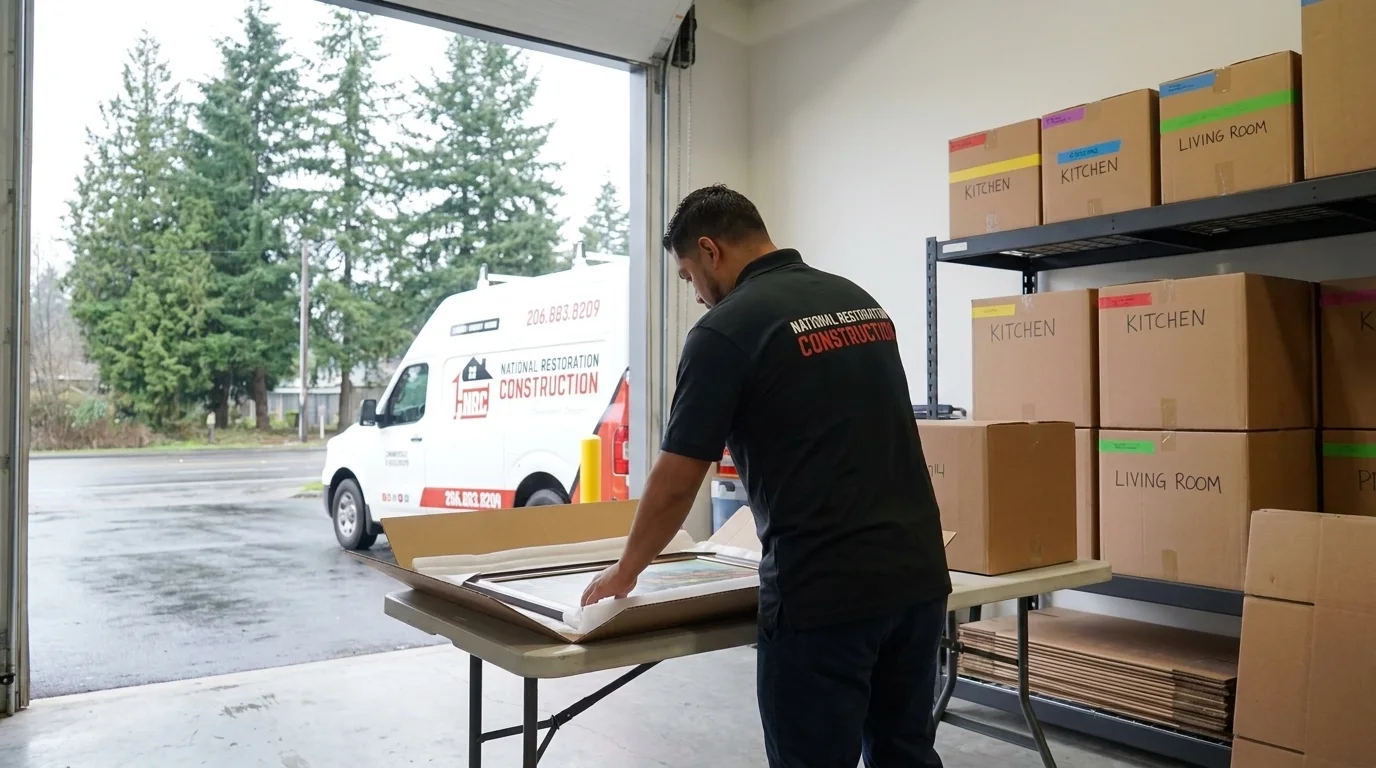
Contents Restoration & Storage in Federal Way
24/7 contents restoration & storage in Federal Way and surrounding areas. IICRC-certified, insurance billing accepted. Call (206) 883-0333.
We work with all insurance carriers and handle the claim paperwork.
Furniture, electronics, and family photos don’t wait for the structural repairs to finish. Once water or smoke has touched your belongings, every day they sit in a damaged house increases the odds that fabric mildews, electronics corrode, or finishes warp beyond saving. Contents restoration separates what can be cleaned and returned from what can’t, and gets everything salvageable out of harm’s way while the structural work happens around it.
What Contents Restoration & Storage actually involves
This service covers the personal property inside a home or business after a water, fire, or smoke event: furniture, clothing, electronics, documents, artwork, and the small stuff that doesn’t show up on an insurance estimate until someone starts looking for it. Work usually starts with a room-by-room inventory and photo record of every item before anything moves, which matters both for your claim and for tracking what came out of which room. Items are then packed out to a climate-controlled facility where they’re separated by material type and damage category: textiles go one direction, electronics another, paper and photographs another again. Cleaning methods vary by what the item actually needs, not a one-size-fits-all wash, and anything exposed to smoke typically needs odor treatment in addition to surface cleaning. Storage can run anywhere from a few weeks to several months depending on how long the structural rebuild takes.
Our process
- Inventory and documentation. Every item is photographed, tagged, and logged before it leaves the property, building the record your adjuster will want to see.
- Pack-out and transport. Contents are boxed and moved to secure, climate-controlled storage, protecting them from the dust, demolition, and temperature swings of an active construction site.
- Item-level triage. Each piece is assessed for what it actually needs: ultrasonic cleaning for hard goods, specialty laundering for textiles, electronics assessment, and document or photograph stabilization.
- Odor and contamination treatment. Smoke-affected items go through deodorization separate from basic cleaning, since surface soot and absorbed odor don’t respond to the same process.
- Pack-back. Once the structure is cleared for reoccupancy, items are returned, unpacked, and placed, with the inventory reconciled against what left the house.
What separates a good contents restoration response from a bad one
The most common failure point is skipping documentation at the front end. Without a photographed, itemized inventory made before pack-out, there’s no clean way to prove what existed, what condition it was in, or what was lost, and that gap is exactly where claims get disputed. A second failure is treating contents restoration like a single process instead of several: running smoke-damaged upholstery through the same wash as waterlogged clothing misses the odor-causing residue sitting below the surface. Storage conditions matter too. Boxes left in a garage or non-climate-controlled unit for months can develop secondary mold even after the original water event is long resolved, which turns a cleaning job into a replacement claim. Adjusters generally want to see a clear line between salvageable and non-salvageable items, with photos and a cleaning attempt noted before anything gets written off, rather than a blanket decision made on-site without testing.
What does Contents Restoration & Storage cost?
Costs depend heavily on volume, the type of damage, and how long items need to stay in storage, so a single-room water loss and a whole-home fire loss aren’t comparable. These figures reflect typical industry ranges, not a quote: every loss is different, and National Restoration Construction provides a written scope of work before any pack-out or cleaning begins. Homeowners insurance commonly covers contents cleaning and temporary storage under the personal property portion of a policy, though coverage details and depreciation schedules vary by carrier.
| Scenario | Typical range |
|---|---|
| Single room pack-out and cleaning | $800 - $2,500 |
| Fire-damaged textiles and upholstery cleaning | $500 - $2,000 |
| Electronics and document restoration | $200 - $1,500 per category |
| Whole-home contents storage (per month) | $300 - $900 |
| Full-home pack-out after a major fire or flood | $5,000 - $15,000+ |
Seasonal & regional considerations
Federal Way’s wet, mild winters mean contents pulled from a flooded crawlspace or burst pipe often carry more moisture than they appear to on the surface, which makes fast pack-out and proper drying before storage more important here than in drier climates. During the region’s wetter months, items left boxed in an uncontrolled space are at real risk of mildew setting in before anyone notices, so the gap between damage and pack-out is worth minimizing.
Service area
Based in Federal Way, National Restoration Construction handles contents restoration and storage throughout Federal Way and nearby communities including Tacoma, Auburn, Kent, Des Moines, and the surrounding South Sound area.
If water or fire has reached your belongings, the window to save them is shorter than it feels. Schedule a contents inventory and pack-out assessment with National Restoration Construction at (206) 883-0333 before more items become total losses.
Services We Handle
- Contents Restoration
Frequently Asked Questions
Does homeowners insurance cover contents restoration and storage?
How do you decide what's salvageable versus a total loss?
Will my belongings smell like smoke after cleaning?
How long do contents typically stay in storage?
What should I document before a pack-out crew arrives?
Looking for the best contents restoration & storage company in Federal Way?
National Restoration Construction provides licensed and insured contents restoration & storage in Federal Way, WA and the surrounding area, and has served local property owners since 2004. Customers rate us 5.0 out of 5 stars across 66 Google reviews. We answer calls 24/7 — call (206) 883-0333 for immediate help.
Need Contents Restoration & Storage now?
We respond 24/7 across Federal Way and surrounding WA cities.
Related Coverage
- Our Restoration Services
- Contact National Restoration Construction
- Restoration Services in Algona
- Restoration Services in Auburn
- Restoration Services in Bellevue
- Restoration Services in Bremerton
- Restoration Services in Burien
- Restoration Services in Des Moines
- Restoration Services in Edgewood
- Restoration Services in Everett
- Restoration Services in Fife
- Restoration Services in Gig Harbor
- Restoration Services in Kent
- Restoration Services in Kirkland