
Crawl Space Encapsulation in Federal Way
24/7 crawl space encapsulation in Federal Way and surrounding areas. IICRC-certified, insurance billing accepted. Call (206) 883-0333.
We work with all insurance carriers and handle the claim paperwork.
A musty smell rising through floor vents, insulation sagging between the joists, or condensation beading on ductwork underneath the house usually traces back to one place: an open or failing crawl space. In Federal Way’s clay soils and high water table, that space stays damp most of the year, and the moisture doesn’t stay contained. It moves upward into subfloors, framing, and eventually the living space above. Crawl space encapsulation seals that moisture out before it compromises the wood or feeds mold growth you can’t see.
What Crawl Space Encapsulation actually involves
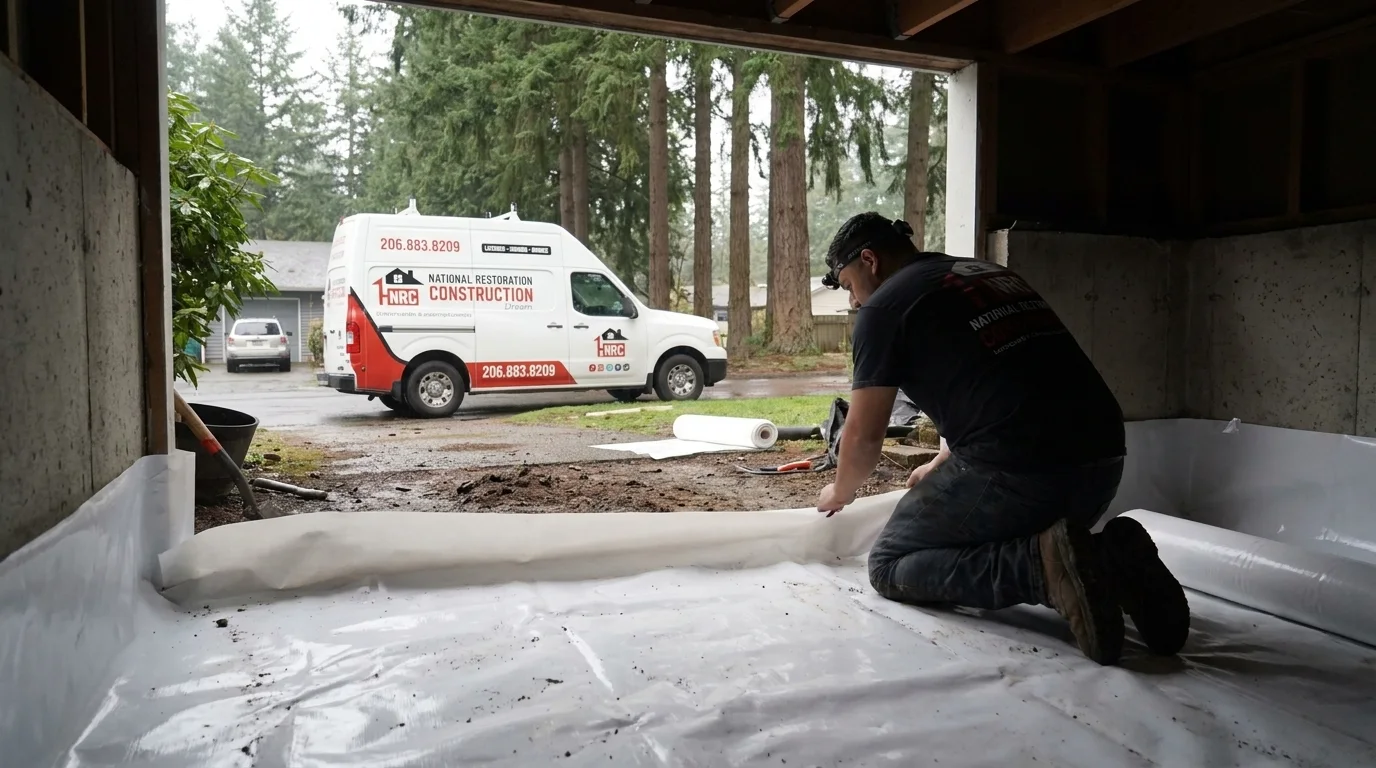
Encapsulation means sealing the crawl space off from ground moisture and outside air with a heavy-duty vapor barrier, typically 12 to 20 mil reinforced polyethylene, run up the foundation walls and piers and sealed at every seam. It’s different from just laying plastic sheeting on the dirt. A proper system addresses the foundation vents, the rim joists, and often includes a dehumidifier or conditioned supply air to keep relative humidity below the threshold where mold and wood rot take hold. Most jobs on an average single-family crawl space run one to two days once drainage issues, if any, are resolved. Framing and subfloor condition get documented with moisture meter readings before the barrier goes down, which matters later if there’s ever a question about what state the space was in before work started.
Our process
- Moisture and structural assessment. We check framing moisture content, look for existing mold, rot, pest entry points, and evaluate whether bulk water (standing water, active seepage) needs to be addressed before anything else happens.
- Drainage correction, if needed. Encapsulating over a space that still collects water just traps it. If grading, a sump pump, or interior drainage channel is needed, that goes in first.
- Surface prep and debris removal. Old insulation, failed plastic sheeting, and construction debris come out. Exposed wood gets treated if rot or mold is present.
- Vapor barrier installation. Reinforced poly sheeting is sealed to the foundation walls, piers, and overlapping seams are taped, not just draped loose over the dirt.
- Humidity control and final readings. A dehumidifier or mechanical ventilation gets installed and commissioned, and we take final moisture readings to confirm the space is holding under target humidity.
What separates a good Crawl Space Encapsulation response from a bad one
The most common shortcut is sealing the ground without addressing why water is getting in. If a crawl space floods seasonally or has a high water table pushing moisture up through the soil, a vapor barrier alone will float, tear, or trap standing water underneath it. A second common mistake is leaving foundation vents open after encapsulating, which lets humid summer air back in and causes condensation on the now-sealed surfaces, the opposite of the intended result. Thin, unsealed 6-mil plastic is sometimes sold as encapsulation when it isn’t; seams separate within a year or two and the barrier stops doing its job. Insurance adjusters and home inspectors both look for the same thing: documented before-and-after moisture readings on the framing, and photos showing the barrier properly sealed at the foundation walls rather than just laid flat on the ground.
What does Crawl Space Encapsulation cost?
Costs vary with crawl space size, whether drainage correction is needed first, and whether a dehumidifier is part of the system. These are typical industry ranges, not a quote: National Restoration Construction provides a written scope of work specific to your crawl space before any work begins, since every foundation and moisture situation is different. Homeowners insurance generally does not cover encapsulation as a standalone improvement, but it may apply when the work is tied to a covered loss such as a burst pipe or failed sump pump that caused the moisture problem in the first place.
| Scenario | Typical range |
|---|---|
| Vapor barrier upgrade, small crawl space, no drainage issues | $1,500 - $3,000 |
| Full encapsulation, average single-family crawl space | $3,500 - $6,500 |
| Encapsulation with drainage correction or sump pump install | $5,000 - $9,000 |
| Encapsulation with dehumidifier system | $6,000 - $10,500 |
| Encapsulation plus structural wood repair or joist sistering | $8,000 - $14,000+ |
Seasonal & regional considerations
Federal Way sits in a region where wet-season rainfall from October through April keeps the water table high, and many crawl spaces built from the 1960s through the 1980s were never designed with vapor control in mind. Summer brings a second issue: warm, humid outside air meeting the cooler surfaces of an unsealed crawl space causes condensation on ductwork and framing even when there’s no standing water at all. A properly sealed and conditioned crawl space handles both ends of that cycle without relying on the weather to cooperate.
Service area
We work on crawl space encapsulation throughout Federal Way and nearby South King and Pierce County communities, including Auburn, Kent, Des Moines, Milton, and Tacoma.
If you’ve noticed a musty smell in the house, soft or spongy flooring, or visible moisture under the house, schedule a crawl space moisture assessment before the damage spreads further into the structure above it.
Frequently Asked Questions
Does homeowners insurance cover crawl space encapsulation?
What's the difference between a vapor barrier and full crawl space encapsulation?
Do you address standing water before encapsulating a crawl space?
Will encapsulation stop the musty smell in my house?
Do I need a dehumidifier if I encapsulate my crawl space?
How long does crawl space encapsulation take to complete?
Looking for the best crawl space encapsulation company in Federal Way?
National Restoration Construction provides licensed and insured crawl space encapsulation in Federal Way, WA and the surrounding area, and has served local property owners since 2004. Customers rate us 5.0 out of 5 stars across 66 Google reviews. We answer calls 24/7 — call (206) 883-0333 for immediate help.
Need Crawl Space Encapsulation now?
We respond 24/7 across Federal Way and surrounding WA cities.
Related Coverage
- Our Restoration Services
- Contact National Restoration Construction
- Restoration Services in Algona
- Restoration Services in Auburn
- Restoration Services in Bellevue
- Restoration Services in Bremerton
- Restoration Services in Burien
- Restoration Services in Des Moines
- Restoration Services in Edgewood
- Restoration Services in Everett
- Restoration Services in Fife
- Restoration Services in Gig Harbor
- Restoration Services in Kent
- Restoration Services in Kirkland
- Crawl Space Encapsulation in Browns Point
- Crawl Space Encapsulation in Fife Heights
- Crawl Space Encapsulation in Milton
- Crawl Space Encapsulation in North Puyallup
- Crawl Space Encapsulation in Pacific
- Crawl Space Encapsulation in Seattle
- Crawl Space Encapsulation in Sumner
- Crawl Space Encapsulation in Tacoma