
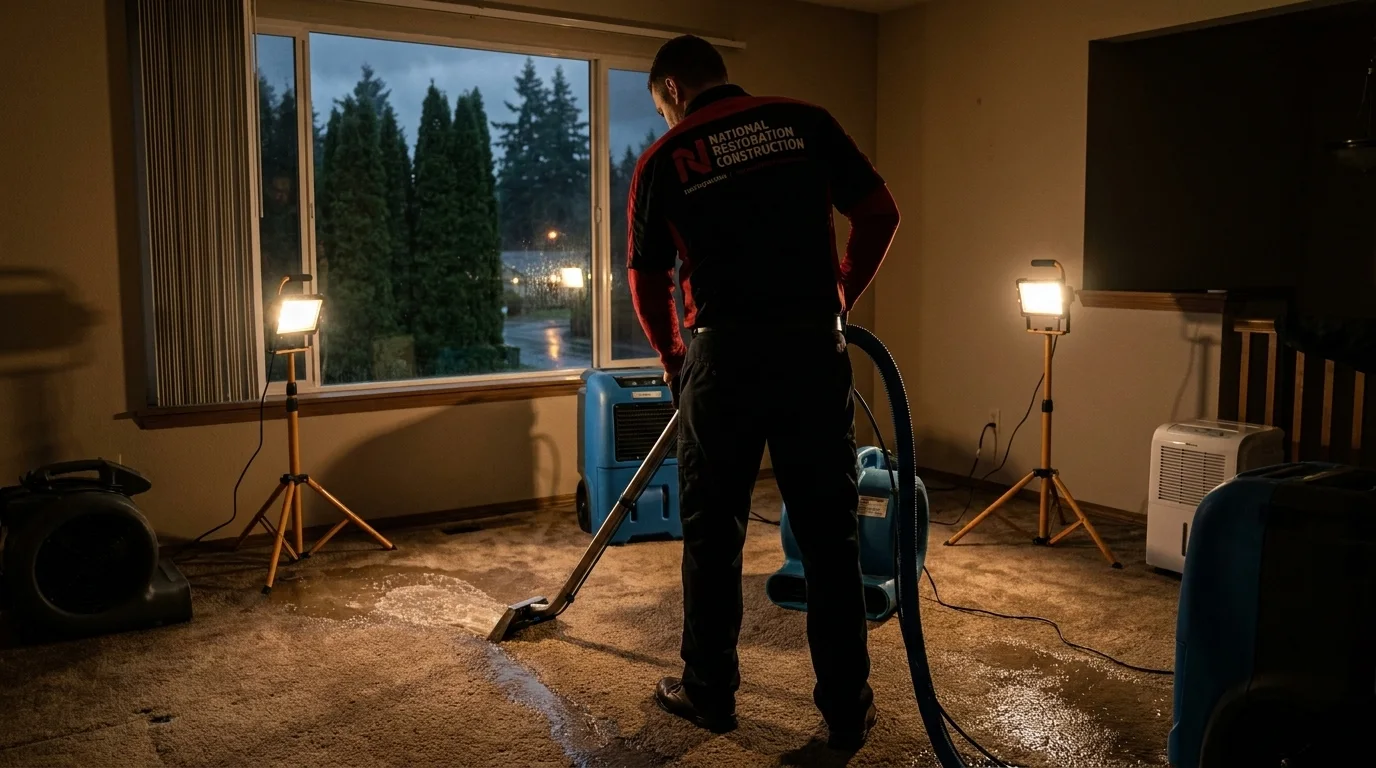
24/7 Emergency Water Removal & Cleanup in Federal Way
24/7 emergency water removal and cleanup in Federal Way and surrounding areas. IICRC-certified, insurance billing accepted. Call (206) 883-0333.
We work with all insurance carriers and handle the claim paperwork.
Standing water does not wait. Within the first hour, it migrates under baseboards, wicks into drywall, and begins saturating subfloor panels that may look perfectly dry from above. By 24 hours, Category 1 clean water can degrade to Category 2 as it contacts building materials and organic debris. Emergency water removal and cleanup is the race to stop that clock: extracting standing water, identifying hidden moisture, and setting the drying conditions that determine whether you’re looking at a repair or a full gut.
What emergency water removal and cleanup actually involves
The work starts with water extraction, but extraction is only the first step in a multi-day process. Industrial truck-mounted or portable extractors remove standing water from flooring, carpet, and subfloor cavities far faster than any shop vac. Once the visible water is gone, the real diagnostic work begins.
Moisture meters and thermal imaging cameras reveal what the eye cannot. Water behind plaster can read dry at the surface while the lath behind it stays saturated. Hardwood floors may show no cupping yet for 48 hours while the subfloor beneath holds significant moisture content. Insulation inside wall cavities absorbs water and holds it against framing members, creating ideal conditions for mold colonization within 48 to 72 hours of the initial loss.
Structural drying uses a combination of high-volume air movers and commercial-grade refrigerant or desiccant dehumidifiers. The equipment is sized to the affected area, the building’s construction type, and the water category. Drying typically runs continuously for three to five days, with moisture readings logged at each visit to confirm the structure is trending toward dry standard. Affected materials that cannot be dried in place, such as saturated insulation or wicking drywall, are removed to expose framing and allow airflow to reach every surface.
Our process
-
Loss assessment and water categorization. Before any equipment is placed, the source of water is identified and, where possible, stopped. Water is categorized by contamination level: Category 1 (clean supply line), Category 2 (gray water from appliances or overflow), or Category 3 (sewage or floodwater). Category determines containment requirements, PPE, and disposal protocols for removed materials.
-
Standing water extraction. Truck-mounted or portable extractors remove bulk water from all affected surfaces. Carpet and pad are evaluated: saturated pad is almost always removed because it cannot be dried in place without trapping moisture against the subfloor. Extraction also covers crawl spaces and basement sumps where water has pooled.
-
Moisture mapping and documentation. Every affected room is mapped with moisture meter readings and, where warranted, thermal imaging. Readings are recorded by location and logged with photos. This documentation serves two purposes: it guides drying equipment placement, and it creates the evidence trail your insurance adjuster needs to authorize the scope of work.
-
Structural drying with calibrated equipment. Air movers and dehumidifiers are placed according to the drying plan. Equipment runs continuously. Daily monitoring visits confirm moisture is dropping at the expected rate. If a wall cavity or subfloor is not drying on schedule, the drying plan is adjusted, which may mean opening walls or removing additional flooring.
-
Final clearance readings and demobilization. Drying is complete when affected materials reach the dry standard for their material type, confirmed by meter readings consistent across multiple visits. Equipment is removed only after clearance, not on a calendar schedule.
What separates a good water removal and cleanup response from a bad one
The most common failure in emergency water removal is stopping too soon. Visible water is gone, surfaces feel dry to the touch, and equipment is pulled before moisture readings confirm the structure has reached dry standard. The result shows up weeks later: buckled hardwood, musty odor behind walls, or mold growth that requires a separate remediation scope.
A second common problem is misclassifying water category. Clean water from a supply line is straightforward, but water that has sat for more than 24 hours, contacted soil, or traveled across flooring with cleaning product residue may qualify as Category 2. Using Category 1 protocols on Category 2 water means inadequate containment and the potential for cross-contamination of unaffected areas.
Insurance adjusters look for moisture logs with date-stamped readings, photographic documentation of affected materials before removal, and a written drying plan that matches the equipment placed. Gaps in documentation are the most common reason supplemental claims are delayed or disputed. IICRC-certified technicians are trained to produce this documentation as part of the job, not as an afterthought.
Lead-containing paint and building materials are a real consideration in Federal Way’s older housing stock. Disturbing lead-containing materials during water removal without proper protocols creates a secondary hazard. National Restoration Construction holds Lead-Safe Certified Firm status through the EPA, which governs how affected materials are handled and disposed.
What does emergency water removal and cleanup cost?
Typical costs depend on the size of the affected area, the water category, and how much structural material requires removal and drying. Most homeowners pay somewhere in the ranges below, based on industry-typical figures.
| Scenario | Typical range |
|---|---|
| Single room, Category 1 (clean water) | $1,200 to $3,500 |
| Multi-room, Category 1, no material removal | $3,000 to $6,500 |
| Single room, Category 2 (gray water) | $2,500 to $5,500 |
| Multi-room, Category 2 with drywall removal | $5,000 to $12,000 |
| Category 3 (sewage or floodwater), any size | $7,000 to $25,000+ |
| Crawl space water intrusion | $2,000 to $8,000 |
Every loss is different, and National Restoration Construction provides a written scope of work before any work begins. Homeowners insurance typically covers sudden and accidental water losses, including burst pipes, appliance failures, and storm-driven intrusion, but policies vary on flood water from ground saturation, so reviewing your declarations page with your adjuster is worthwhile.
Seasonal and regional considerations
Federal Way sits in a climate where the wet season runs from October through April, and the region averages significant annual rainfall concentrated in those months. That sustained moisture load means crawl spaces, flat or low-slope roofs, and window wells are under consistent pressure for half the year. Freeze events are less frequent than further inland but do occur, and when they do, supply lines in unconditioned spaces and exterior hose bibs are the first to fail.
The area’s housing stock includes a substantial number of homes built in the 1960s through 1980s with original galvanized supply lines, which corrode from the inside out and can fail without warning. Slab-on-grade construction, common in parts of Federal Way and surrounding communities, concentrates water damage differently than homes with crawl spaces: water has nowhere to drain and spreads laterally under the slab finish, making moisture mapping especially important.
Service area
National Restoration Construction is headquartered in Federal Way and serves communities throughout King and Pierce counties, including Auburn, Kent, Renton, Tacoma, Puyallup, Burien, Des Moines, and surrounding areas. City-specific pages for each community link back to this page for full service detail.
If you are standing in a wet room right now, call (206) 883-0333 to schedule your moisture assessment. The sooner extraction and drying equipment is in place, the narrower the scope of damage.
Services We Handle
- 24/7 Emergency Water Cleanup
- Emergency Water Extraction
- Flood Water Removal
- Standing Water Removal
Frequently Asked Questions
Does homeowners insurance cover emergency water removal and cleanup?
How long does structural drying typically take after a water loss?
What is the difference between Category 1, 2, and 3 water, and why does it matter for water removal and cleanup?
What should I do while waiting for the emergency water removal crew to arrive?
How do technicians find water damage that is not visible?
Watch: Emergency Water Removal & Cleanup in Federal Way
Looking for the best emergency water removal & cleanup company in Federal Way?
National Restoration Construction provides licensed and insured emergency water removal & cleanup in Federal Way, WA and the surrounding area, and has served local property owners since 2004. Customers rate us 5.0 out of 5 stars across 66 Google reviews. We answer calls 24/7 — call (206) 883-0333 for immediate help.
Need Emergency Water Removal & Cleanup now?
We respond 24/7 across Federal Way and surrounding WA cities.
Related Coverage
- Our Restoration Services
- Contact National Restoration Construction
- Restoration Services in Algona
- Restoration Services in Auburn
- Restoration Services in Bellevue
- Restoration Services in Bremerton
- Restoration Services in Burien
- Restoration Services in Des Moines
- Restoration Services in Edgewood
- Restoration Services in Everett
- Restoration Services in Fife
- Restoration Services in Gig Harbor
- Restoration Services in Kent
- Restoration Services in Kirkland
- 24/7 Emergency Water Damage Restoration in Federal Way