
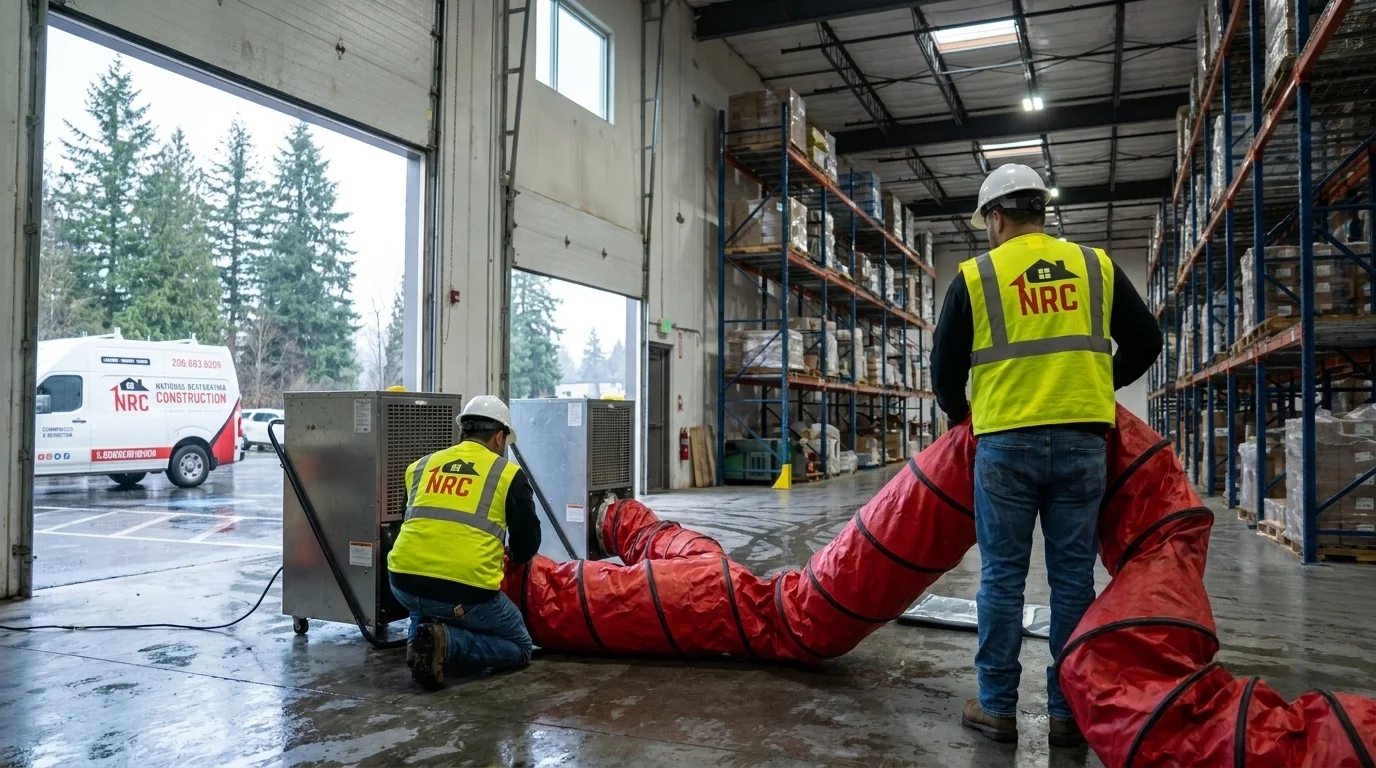
Industrial Restoration in Federal Way
24/7 industrial restoration in Federal Way and surrounding areas. IICRC-certified, insurance billing accepted. Call (206) 883-0333.
We work with all insurance carriers and handle the claim paperwork.
When a forklift punctures a sprinkler line in a distribution center, or a press room fire shuts down a production line, the math changes fast. It’s not just the structure, it’s the racking, the conveyor systems, the electrical panels, and every hour of downtime that follows. Industrial restoration deals with large-footprint losses where speed, documentation, and coordination with plant operations matter as much as the drying equipment itself.
What Industrial Restoration actually involves
Industrial and warehouse facilities present different problems than a house or small office. Concrete slabs hold moisture longer than residential subfloors and can read dry at the surface while trapped water sits in control joints and under sealed coatings for weeks. High-bay racking and stored inventory have to be moved, assessed for contamination, or written off before drying can even start. Manufacturing facility restoration often means working around equipment that can’t get wet twice, electrical systems that need to be de-energized and inspected before power returns, and HVAC systems serving square footage measured in acres rather than rooms.
Equipment on a job like this scales up accordingly: low-grain refrigerant and desiccant dehumidifiers sized for industrial air volumes, axial fans for open-span drying, and moisture meters capable of reading through concrete and masonry. Timeline depends heavily on the building envelope and what got wet, a clean water loss in a single bay can dry in days, while a loss that reached insulation, structural steel connections, or below-slab utilities can run considerably longer.
Our process
- Facility assessment and shutdown coordination - we walk the affected zones with facility management or plant engineering to understand what’s load-bearing, what’s live electrical, and what production areas need to stay isolated.
- Moisture mapping across the slab and envelope - thermal imaging and penetrating moisture meters identify how far water traveled under flooring, through tilt-up panel joints, or along utility chases, not just where it’s visible.
- Phased extraction and drying by zone - rather than treating the whole facility as one loss, we section the space so operational areas can potentially reopen while drying continues elsewhere.
- Equipment and inventory triage - stored product, pallets, and fixed equipment get documented and separated into salvageable, questionable, and loss categories before cleanup proceeds.
- Monitoring and reinstatement - daily moisture readings until target levels are met, then coordination on flooring, electrical, and racking reinstallation so the facility comes back online in order.
What separates a good industrial restoration response from a bad one
The most common mistake on large-loss industrial jobs is treating the slab like it’s dry once the surface meter reads low. Concrete releases moisture slowly, and sealing a floor or setting racking back down before the slab has actually equilibrated is how facilities end up with coating failures and secondary moisture problems months later. A second common gap is skipping electrical inspection before power is restored to equipment that sat in standing water, visible dryness doesn’t mean the motor windings or control panels are safe to energize.
Adjusters reviewing industrial fire damage or industrial water damage claims are looking for the same things: time-stamped moisture logs, photos of affected zones before demolition starts, and a clear line between pre-loss condition and damage. A written scope that separates structure, contents, and business interruption documentation tends to move through claims faster than a lump-sum invoice. Plant restoration services that skip this documentation step often leave the property owner negotiating coverage gaps after the fact.
What does Industrial Restoration cost?
Industrial losses vary more than almost any other restoration category because facility size, equipment value, and whether production has to stop all factor in. Most property owners should expect a range rather than a flat figure, and every loss gets a written scope from National Restoration Construction before work begins so there are no surprises once the job is underway.
| Scenario | Typical range |
|---|---|
| Localized water loss, small warehouse bay (under 5,000 sq ft) | $8,000 - $25,000 |
| Multi-zone water intrusion, mid-size facility | $40,000 - $150,000 |
| Smoke and fire damage, single production line | $75,000 - $250,000 |
| Large-loss structural drying, distribution center | $100,000 - $400,000+ |
| Storm-related roof or envelope failure | $20,000 - $100,000 |
Commercial property insurance typically covers sudden and accidental damage, such as a burst pipe or a covered fire, along with reasonable mitigation costs; it generally does not cover gradual deterioration or deferred maintenance issues, so documentation of cause matters for claim approval.
Seasonal & regional considerations
Federal Way and the surrounding industrial corridor see sustained wet-season rainfall from fall through spring, and a lot of the warehouse and manufacturing stock in this part of the Puget Sound region uses flat or low-slope roofing, EPDM membranes and built-up roofing that are prone to ponding and slow leaks rather than dramatic failures. Those slow leaks are often what turn into larger structural drying jobs, because they go unnoticed until insulation or steel decking has been wet for weeks. Facilities near the lower Green River valley should also account for a higher water table, which affects how slabs and below-grade utility rooms dry after a significant water event.
Service area
National Restoration Construction works with warehouse, manufacturing, and distribution facilities throughout Federal Way and the surrounding industrial areas, including Kent, Auburn, Tacoma, Des Moines, and SeaTac.
If your facility has active water intrusion, fire damage, or a slab that’s holding moisture it shouldn’t, call (206) 883-0333 to get a licensed general contractor crew scoping the loss and a written plan in front of you before more product, equipment, or downtime is at stake.
Frequently Asked Questions
Does homeowners or commercial insurance cover industrial restoration?
How do you dry a concrete slab in a warehouse without shutting the whole facility down?
What happens to racking, pallets, and stored inventory during a water or fire loss?
Why does equipment need an electrical inspection before power is restored after a water loss?
How long does a large industrial restoration project typically take?
Looking for the best industrial restoration company in Federal Way?
National Restoration Construction provides licensed and insured industrial restoration in Federal Way, WA and the surrounding area, and has served local property owners since 2004. Customers rate us 5.0 out of 5 stars across 66 Google reviews. We answer calls 24/7 — call (206) 883-0333 for immediate help.
Need Industrial Restoration now?
We respond 24/7 across Federal Way and surrounding WA cities.
Related Coverage
- Our Restoration Services
- Contact National Restoration Construction
- Restoration Services in Algona
- Restoration Services in Auburn
- Restoration Services in Bellevue
- Restoration Services in Bremerton
- Restoration Services in Burien
- Restoration Services in Des Moines
- Restoration Services in Edgewood
- Restoration Services in Everett
- Restoration Services in Fife
- Restoration Services in Gig Harbor
- Restoration Services in Kent
- Restoration Services in Kirkland