
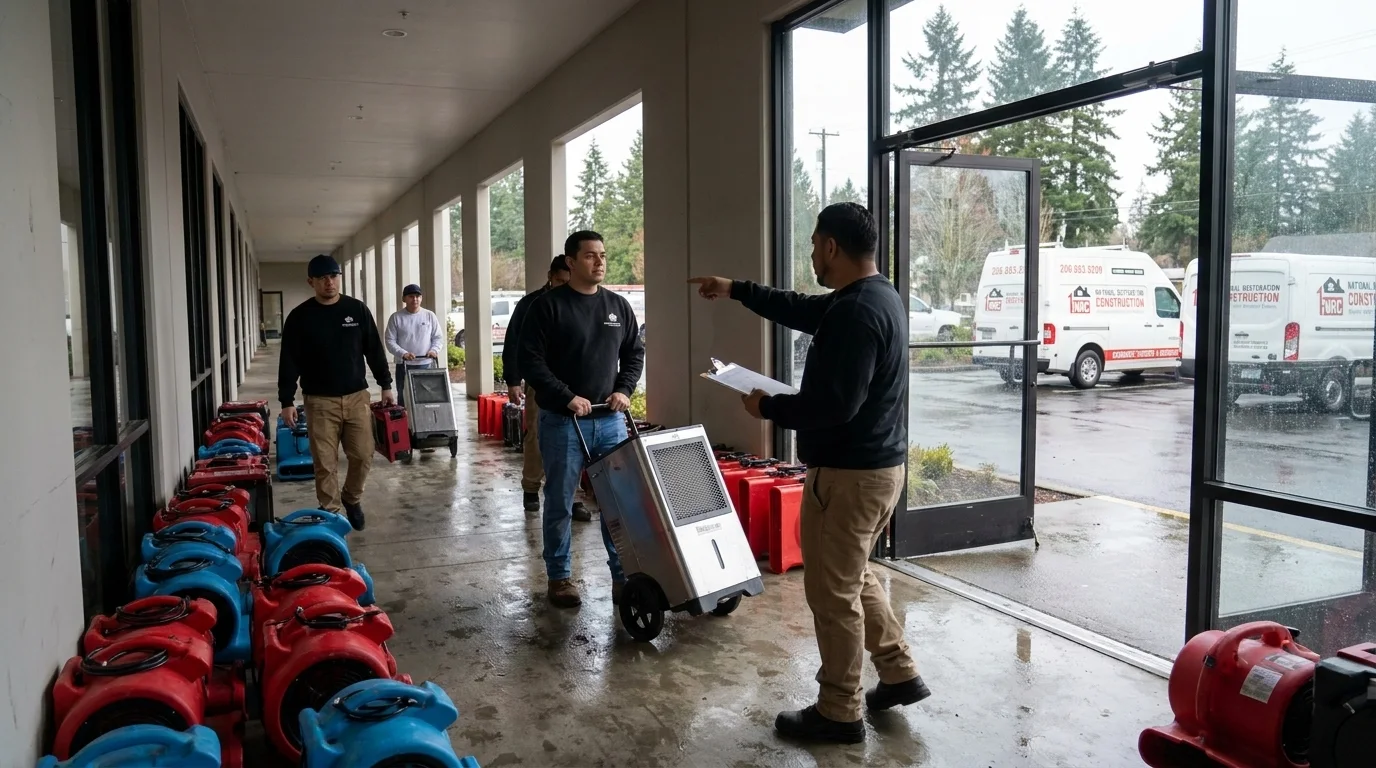
Large Loss and Catastrophic Response in Federal Way
24/7 large loss and catastrophic response in Federal Way and surrounding areas. IICRC-certified, insurance billing accepted. Call (206) 883-0333.
We work with all insurance carriers and handle the claim paperwork.
When a loss spreads across multiple floors, units, or buildings, the standard playbook stops working. A single apartment complex with water intrusion on three floors, a commercial building with fire damage that compromised structural framing, or a storm event that hit a dozen properties at once all need something different: a response built around parallel crews, a dedicated project manager, and documentation detailed enough to support a claim that may run into six or seven figures. That’s the gap large loss and catastrophic response is built to close.
What Large Loss and Catastrophic Response actually involves
Industry-wide, a loss is typically classified as “large” once it crosses roughly $50,000 to $100,000 in anticipated restoration and reconstruction costs, or once it involves multiple units, structures, or a commercial operation with business interruption exposure. At that scale, the work isn’t just bigger, it’s structured differently. Instead of one crew working a linear path, you need several crews running extraction, demolition, and drying simultaneously in different zones, backed by enough desiccant dehumidification capacity, air movers, and generator power to cover the footprint without bottlenecking. National Restoration Construction holds a General Contractor Certificate of Registration, which matters here because large loss jobs almost always carry into reconstruction, structural repair, and multi-trade coordination, not just mitigation.
Our process
- Rapid-scale mobilization and triage. Crews and equipment are staged across the full affected footprint at once, with an initial safety and structural walkthrough to flag compromised framing, electrical hazards, or areas needing engineering review before anyone enters.
- Full-scope documentation. Moisture mapping, photographic logs, and affected-material inventories are built out unit by unit or zone by zone, producing a line-item scope that matches the detail carriers and third-party administrators expect on a large claim.
- Parallel mitigation across trades. Extraction, containment, and demolition run concurrently in separate zones instead of sequentially, which is the difference between a four-week mitigation phase and a four-month one on a multi-structure loss.
- Dedicated project management. One point of contact tracks daily progress logs, psychrometric readings, and equipment run times, and coordinates walk-throughs with adjusters so the paper trail keeps pace with the physical work.
- Reconstruction handoff. Once drying and demolition are verified complete, the same team carries the job into permitting, framing, and finish work rather than handing it to a separate contractor who has to re-learn the scope.
What separates a good large loss response from a bad one
The most common failure on large claims is fragmentation: a mitigation company handles the water or fire portion, then disappears, and a general contractor starts reconstruction weeks later without ever seeing the original moisture logs. That gap is where disputes with carriers happen, because the documentation doesn’t connect. A good operator keeps one continuous record from first extraction to final punch list, including daily drying logs per zone (not just an average for the building), photos tied to specific units or areas, and an estimate format that lines up with what adjusters and TPAs are already using to process the claim. Under-scoping is the other recurring problem: crews that treat a 40,000 square foot loss like a scaled-up residential job tend to miss hidden moisture in multi-layer assemblies, shared wall cavities, or HVAC systems that carried contamination between units. Structural components affected by fire or prolonged water exposure should get an engineer’s review before reconstruction begins, not an assumption that framing is sound because it’s still standing.
What does Large Loss and Catastrophic Response cost?
Large loss projects don’t price like standard residential claims, so industry ranges below are rough and meant only to set expectations, not a quote. Every loss is different, and National Restoration Construction provides a written scope of work before any mitigation or reconstruction begins so you know what’s included and what isn’t. Most commercial and multi-family property insurance covers large loss mitigation and reconstruction when the cause is a covered peril, though business interruption coverage and policy limits vary significantly and are worth reviewing with your agent early.
| Scenario | Typical industry range |
|---|---|
| Multi-unit apartment building, partial flood (2-3 floors) | $150,000 - $450,000 |
| Commercial office fire with structural involvement | $300,000 - $1,200,000 |
| Mixed-use building, major water intrusion with reconstruction | $250,000 - $900,000 |
| Multi-building storm damage (roof failure, multiple structures) | $500,000 - $2,000,000+ |
| Industrial or warehouse facility, large-scale water or fire loss | $1,000,000 - $3,000,000+ |
Seasonal and regional considerations
Federal Way and the broader Puget Sound region see large loss events most often tied to atmospheric river storms and the windstorms that follow them, which can cause roof failures, wind-driven water intrusion, and tree damage across several buildings on a single property or HOA in the same event. Older multi-family stock built before modern stormwater and roofing codes is more exposed to these cascading failures, which is often why a single storm turns into a true large loss rather than a handful of isolated claims.
Service area
National Restoration Construction handles large loss and catastrophic response for commercial properties, multi-family complexes, and institutional buildings throughout Federal Way and the surrounding South Sound and greater Puget Sound area.
If you’re managing a loss that spans multiple units, floors, or buildings, the scope needs to be right before a single crew mobilizes. Call (206) 883-0333 to start a large loss assessment and get a documented scope of work the carrier can work from.
Frequently Asked Questions
What actually qualifies a loss as "large" instead of a standard claim?
How do you coordinate when multiple adjusters or a third-party administrator are involved?
Can a commercial property stay partially operational during a large loss response?
Does insurance cover large loss and catastrophic restoration?
How is a large, multi-structure loss priced when the scope keeps changing as demolition reveals more damage?
Looking for the best large loss and catastrophic response company in Federal Way?
National Restoration Construction provides licensed and insured large loss and catastrophic response in Federal Way, WA and the surrounding area, and has served local property owners since 2004. Customers rate us 5.0 out of 5 stars across 66 Google reviews. We answer calls 24/7 — call (206) 883-0333 for immediate help.
Need Large Loss and Catastrophic Response now?
We respond 24/7 across Federal Way and surrounding WA cities.
Related Coverage
- Our Restoration Services
- Contact National Restoration Construction
- Restoration Services in Algona
- Restoration Services in Auburn
- Restoration Services in Bellevue
- Restoration Services in Bremerton
- Restoration Services in Burien
- Restoration Services in Des Moines
- Restoration Services in Edgewood
- Restoration Services in Everett
- Restoration Services in Fife
- Restoration Services in Gig Harbor
- Restoration Services in Kent
- Restoration Services in Kirkland