
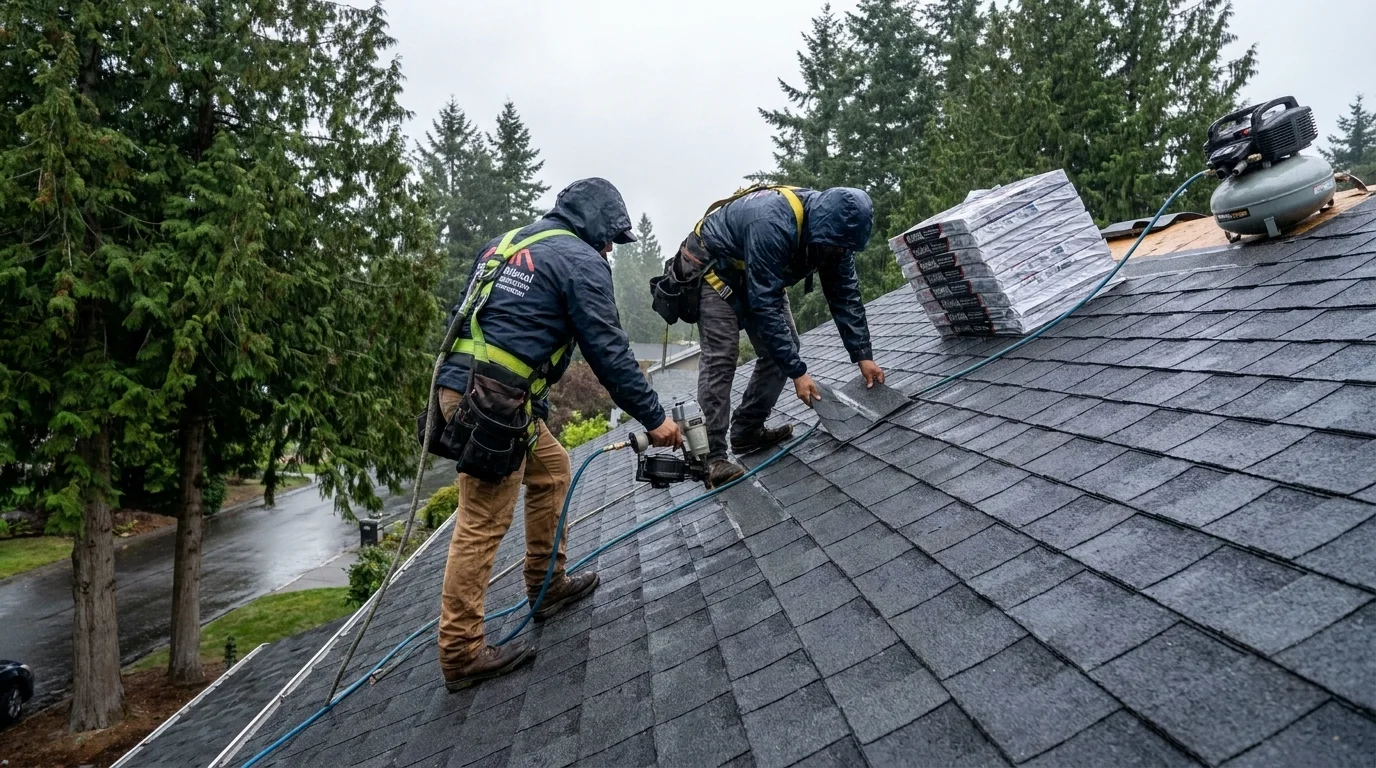
Roofing Installation and Replacement in Federal Way
24/7 roofing installation and replacement in Federal Way and surrounding areas. IICRC-certified, insurance billing accepted. Call (206) 883-0333.
We work with all insurance carriers and handle the claim paperwork.
A roof that’s losing its battle with age doesn’t fail all at once. It fails in stages: granules collecting in the gutters, flashing pulling away at the chimney, a soft spot in the decking that flexes underfoot when you walk the attic. By the time water stains appear on a ceiling, the damage has usually been working inward for months. Roofing installation and replacement stops that cycle at the source, replacing not just the visible surface but the underlayment, flashing, and ventilation components that determine how long the next roof actually lasts.
What roofing installation and replacement actually involves
A full roof replacement is a layered system, not a single material swap. The work begins at the decking: plywood or OSB sheathing is inspected for rot, delamination, and soft spots, and damaged sections are replaced before anything goes over them. A waterproof underlayment goes down next, followed by ice-and-water shield along eaves, valleys, and any penetration point where water tends to pool or back up.
Shingles, metal panels, or tile are then installed according to the manufacturer’s specifications for that product and roof pitch. Flashing is fabricated and set at every transition: chimneys, skylights, dormers, wall intersections, and valleys. Ridge cap and ventilation components close out the system at the top.
Timeline for a standard residential replacement typically runs one to two days for the installation itself, with a day of prep and cleanup on either side. Larger or more complex rooflines, steep pitches, or significant decking replacement extend that window. National Restoration Construction holds General Contractor Certificate of Registration #NATIORC792M6 and carries the certifications required to work on both insurance-related and elective replacement projects.
Our process
-
Roof inspection and scope development. We walk the roof and the attic, document the condition of the decking, underlayment, flashing, ridge, and ventilation, and photograph every area of concern. The written scope identifies what is being replaced, what materials are specified, and why, so there are no surprises when the crew arrives.
-
Material selection and permitting. Shingle weight, wind rating, and color are confirmed with the homeowner. Where local jurisdiction requires a permit for replacement work, we pull it before the job starts. Federal Way and most surrounding cities in King and Pierce counties require permits for full replacements; we handle that process.
-
Tear-off and decking repair. Existing roofing material is removed down to the decking. Any sheathing that is soft, delaminated, or water-damaged is cut out and replaced with matching thickness material. This step is where shortcuts most often get taken on lower-quality jobs, and it is the step that determines whether the new roof performs as warranted.
-
Underlayment, ice-and-water shield, and flashing installation. Waterproofing layers go down before a single shingle is set. Ice-and-water shield is applied along all eaves and in valleys, critical in the Pacific Northwest where freeze-thaw cycles and sustained rain both stress the same vulnerable zones. Step flashing, counter flashing, and valley flashing are fabricated and installed to code.
-
Shingle installation, ridge, and final inspection. Shingles are laid to manufacturer specification for that product’s exposure and fastening pattern. Ridge cap and ventilation components are set last. We do a final walkthrough with the homeowner, confirm gutters and grounds are clear of debris, and provide documentation of materials installed, including manufacturer warranty information.
What separates a good roof replacement from a bad one
The most common failure point on a residential roof replacement is not the shingles. It is everything underneath them. Installers who skip decking inspection, use a single layer of standard felt instead of a proper underlayment system, or reuse old flashing at chimneys and skylights are setting up the next leak before the job is finished.
Flashing is where most callbacks originate. Step flashing at dormers and walls needs to be woven into the shingle courses, not just surface-applied over them. Counter flashing at chimneys needs to be embedded in mortar joints, not caulked to the surface. Caulk fails; properly set metal does not.
Ventilation is the other variable adjusters and inspectors look at closely on insurance claims. Inadequate attic ventilation traps heat and moisture, shortening shingle life and creating the conditions for mold growth in the sheathing. A replacement that does not address ventilation deficiencies is solving half the problem.
What does roofing installation and replacement cost?
Typical costs for residential roofing work vary significantly based on roof size, pitch, material choice, and the condition of the decking underneath. Most homeowners pay somewhere in the ranges below, based on industry-typical figures for the Pacific Northwest region.
| Scenario | Typical range |
|---|---|
| Single-story home, asphalt shingles, good decking | $8,000 – $14,000 |
| Two-story home, asphalt shingles, moderate complexity | $12,000 – $20,000 |
| Significant decking replacement added | $1,500 – $4,000 additional |
| Architectural or impact-resistant shingles | $14,000 – $24,000 |
| Metal roofing, standing seam | $18,000 – $35,000+ |
| Flat or low-slope membrane system | $6,000 – $15,000 |
Every roof is different, and National Restoration Construction provides a written scope of work before any project begins. Homeowners insurance typically covers replacement when the loss is caused by a covered peril such as wind, hail, or storm damage; it does not cover replacement due to age or wear alone, though a thorough inspection report can support a claim when storm damage is present alongside existing wear.
Seasonal and regional considerations
The Pacific Northwest’s rain season runs long, and Federal Way sits in a climate where roofs face sustained moisture from October through April, with occasional freeze-thaw cycles in January and February. Moss and algae growth accelerate on north-facing slopes and under tree canopy, breaking down shingle granules faster than UV exposure alone would. Algae-resistant shingles and proper attic ventilation are not optional upgrades in this region; they are baseline specifications for a roof meant to last its rated lifespan.
Storm season also brings wind events that lift shingles at the edges and ridges, particularly on older installations where the adhesive strips have lost their bond. Catching those failures early, before a sustained rain event drives water into the decking, is the difference between a repair and a full replacement.
Service area
National Restoration Construction is headquartered in Federal Way and serves homeowners and property managers throughout King and Pierce counties, including Auburn, Kent, Renton, Tacoma, Puyallup, Burien, SeaTac, Des Moines, and surrounding communities. The city-specific pages linked from this service cover local permitting contacts and jurisdiction-specific notes for each area.
If your roof is showing signs of failure, or if a storm event has left you uncertain about what’s damaged and what’s sound, the next step is a documented inspection. Call National Restoration Construction at (206) 883-0333 to schedule your roof assessment and get a written scope before any work begins.
Frequently Asked Questions
Does homeowners insurance cover roof replacement?
What is the difference between a roof repair and a full replacement, and how do I know which one I need?
How long does a residential roof replacement take from start to finish?
What roofing materials perform best in the Pacific Northwest climate?
What happens if damaged decking is found during tear-off?
Looking for the best roofing installation and replacement company in Federal Way?
National Restoration Construction provides licensed and insured roofing installation and replacement in Federal Way, WA and the surrounding area, and has served local property owners since 2004. Customers rate us 5.0 out of 5 stars across 66 Google reviews. We answer calls 24/7 — call (206) 883-0333 for immediate help.
Need Roofing Installation and Replacement now?
We respond 24/7 across Federal Way and surrounding WA cities.
Related Coverage
- Our Restoration Services
- Contact National Restoration Construction
- Roofing Installation and Replacement in Algona
- Roofing Installation and Replacement in Auburn
- Roofing Installation and Replacement in Bellevue
- Roofing Installation and Replacement in Bremerton
- Restoration Services in Burien
- Roofing Installation and Replacement in Des Moines
- Roofing Installation and Replacement in Edgewood
- Roofing Installation and Replacement in Everett
- Roofing Installation and Replacement in Fife
- Roofing Installation and Replacement in Gig Harbor
- Roofing Installation and Replacement in Kent
- Roofing Installation and Replacement in Kirkland
- Roofing Installation and Replacement in Port Orchard
- Roofing Installation and Replacement in Redmond
- Roofing Installation and Replacement in Renton
- Roofing Installation and Replacement in Seattle
- Roofing Installation and Replacement in Tacoma
- Roofing Installation and Replacement in University Place