
Water Leak Detection in Tacoma
24/7 water leak detection in Tacoma, WA. IICRC-certified, insurance billing accepted. Call (206) 883-0333.
We work with all insurance carriers and handle the claim paperwork.
Our IICRC-certified technicians are dispatched from our Federal Way, WA headquarters and are typically on-site in Tacoma within 60 minutes of your call.
Hidden water leak in your Tacoma home or business? A pipe that’s been weeping behind a wall or under a slab for weeks doesn’t always announce itself with a puddle. In Tacoma’s older housing stock, especially the early-1900s bungalows and craftsman homes scattered through Stadium District and Proctor District, a slow leak is more likely to show up as a musty smell, a soft spot in the subfloor, or an unexplained spike on the water bill than as visible water. Call now for leak detection service before that slow drip turns into saturated framing or a mold problem nobody wants to find mid-renovation.
Why Tacoma Properties See Hidden Leak Issues
Tacoma’s mix of building eras creates two very different leak profiles. In North Tacoma and the Stadium District, homes built before 1950 often still run on galvanized supply lines that corrode from the inside out, narrowing and eventually pinholing at joints hidden inside plaster walls. In newer construction around South Hill, slab-on-grade foundations are more common, and a slab leak can travel laterally under the concrete before it ever surfaces, sometimes showing up as a warm spot on the floor or a faint hiss when the house is otherwise quiet. Add Tacoma’s clay-heavy soil, which expands and contracts with seasonal moisture and puts steady pressure on buried supply and drain lines, and you get a city where leaks tend to hide rather than announce themselves. Waterfront commercial buildings along Ruston Way face an additional factor: salt spray accelerates corrosion on exterior plumbing and fixtures, which shortens the window before a small leak becomes a real one.
Our Water Leak Detection Process in Tacoma
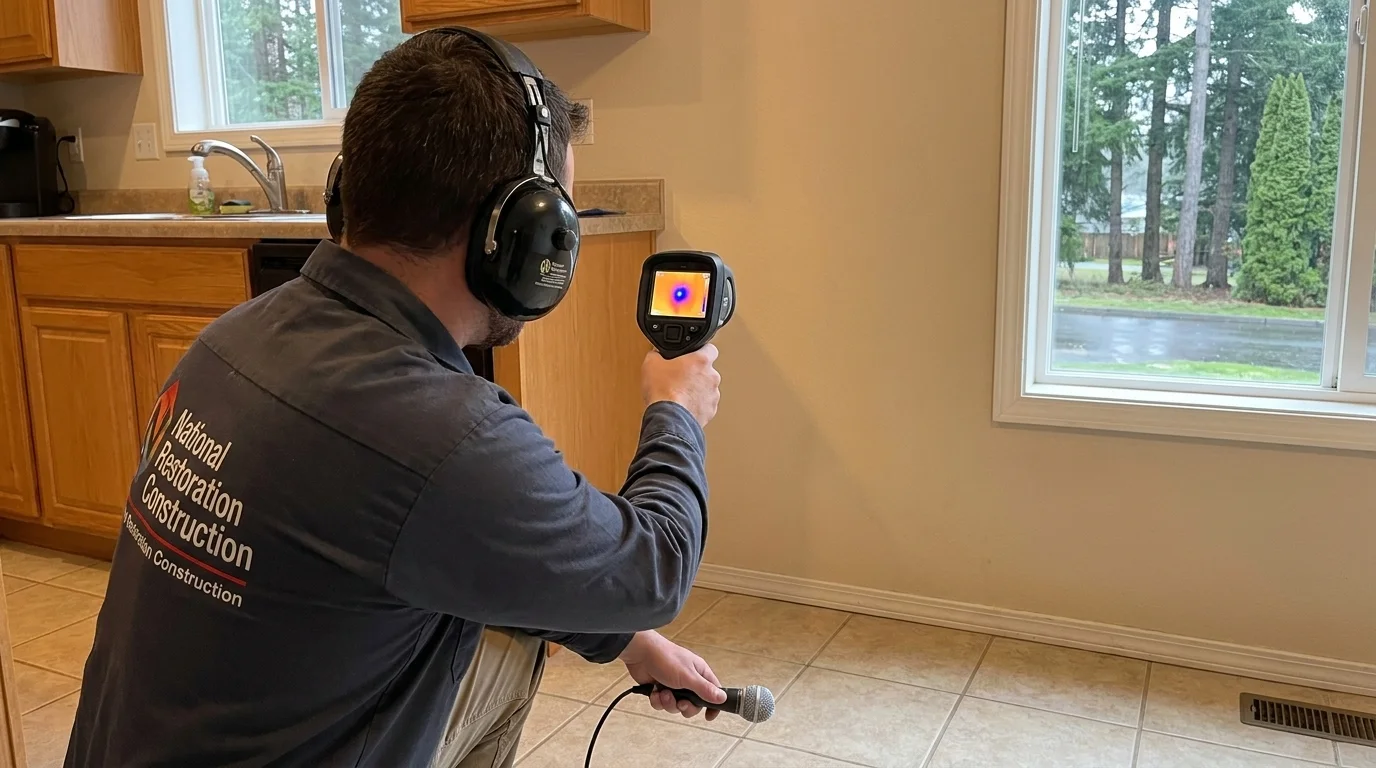
We start with a moisture survey using thermal imaging and non-invasive moisture meters to narrow down the search area before any drywall or flooring comes up. For suspected slab leaks, we bring in acoustic listening equipment that picks up the sound of water moving under concrete, which lets us pinpoint a location within a tight radius rather than guessing across an entire slab. In the pre-1950 homes common around Proctor District and Old Town, we’re careful with plaster walls, since they absorb and hold moisture differently than modern drywall and can mask a leak’s true source if we’re not reading the moisture gradient correctly. Once we’ve confirmed the leak path, we document everything with photos and moisture readings before any access cuts are made, which matters both for the repair plan and for any insurance claim that follows.
Equipment & Methods We Use for Leak Detection
Depending on what the property’s construction tells us, we’ll use infrared thermography to spot temperature differentials where water is displacing air in a wall or ceiling cavity, acoustic sensors for pressurized line leaks under slabs or pavement, and borescope cameras when we need a visual inside a wall cavity without opening the whole section. For older copper and galvanized systems, we also check pressure consistency across the line, since a leak often shows up first as a drop in static pressure before it’s visible anywhere. Any work that generates airborne particulate, such as cutting into plaster or opening a slab penetration, is handled with HEPA filtration in line with Tacoma’s municipal requirements for restoration work.
Local note
Homes within a few blocks of Wright Park and through the Hilltop neighborhood tend to share a plumbing quirk from their original construction era: branch lines were often run through shared wall cavities between adjoining rooms rather than down through the floor joists, which means a leak at one fixture can show up as a stain in a completely different room. Knowing that layout pattern before we open anything saves a lot of unnecessary drywall removal.
If you’re in the 98406 or 98407 area and notice a water bill that doesn’t match your usage, or a cold, damp patch on a slab floor near Point Defiance Park or the Museum of Glass district, it’s worth getting a moisture survey done before the drywall or flooring tells the story for you. National Restoration Construction handles water leak detection throughout Tacoma, from early-1900s homes near Old Town to newer construction on South Hill, and we document everything thoroughly enough to support a repair plan or an insurance claim. Call (206) 883-0333 to schedule a leak detection visit.
Serving Tacoma from our Federal Way headquarters — ★ 5.0 · 66 Google reviews
“Had a water emergency on site. These guys showed up the next day and started taking care of business! took a few days to get all the water out/ damage ripped out. Those guys worked hard! Communication with the guys in the office was easy and fast. Overall, very happy. Would recommend.” — Benjamin, August 2026Read our reviews on Google →
Water Leak Detection in Tacoma: Service Coverage
Frequently Asked Questions
How fast can you arrive for water leak detection in Tacoma?
How do you detect a slab leak in a South Hill home without tearing up the floor?
Are the older homes in Stadium District and Proctor District more prone to hidden leaks?
Does Tacoma's HEPA filtration requirement apply to leak detection work?
Can a hidden leak affect my insurance claim if we're in the 98402 or 98404 area?
What's different about leak detection in waterfront buildings near Ruston Way?
Water Leak Detection response in Tacoma
Most Tacoma calls see a technician on-site within 60 minutes from our Federal Way headquarters.