
Water Leak Detection in Federal Way
24/7 water leak detection in Federal Way and surrounding areas. IICRC-certified, insurance billing accepted. Call (206) 883-0333.
We work with all insurance carriers and handle the claim paperwork.
A water bill that climbs for no reason, a warm patch on the slab, a musty smell behind a baseboard that won’t go away no matter how many times you clean it: these are the quiet signals of a leak that hasn’t announced itself yet. By the time water stains bloom on a ceiling or a wall starts to bow, the leak has usually been running for weeks. Water leak detection finds the source before it becomes a demolition project, using equipment that reads moisture and temperature differences inside materials without opening up the whole wall or floor first.
What water leak detection actually involves
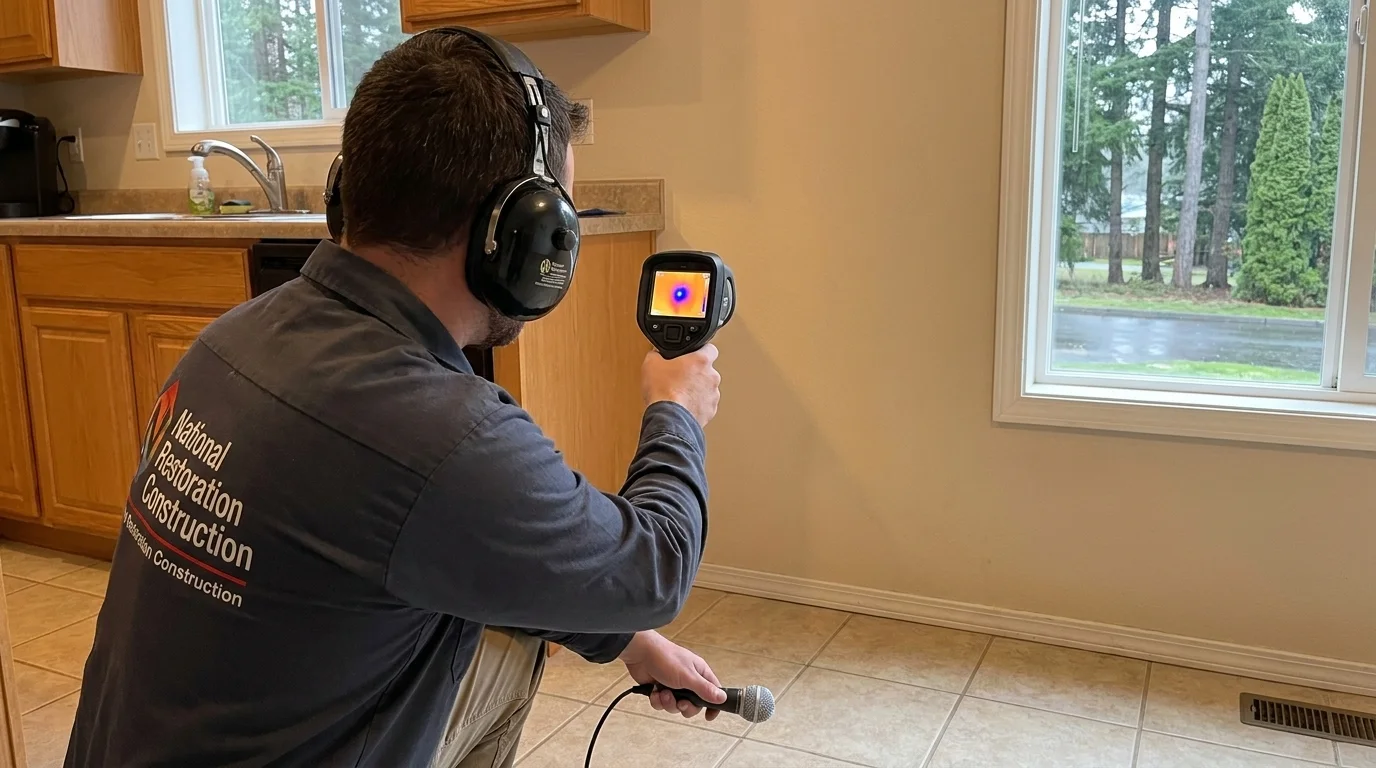
This is diagnostic work, not guesswork. A technician uses a combination of thermal imaging, moisture meters, and acoustic listening equipment to trace where water is traveling versus where it’s actually originating, which are often two different places. Water follows gravity and the path of least resistance along framing members, so a stain on a first-floor ceiling might trace back to a second-floor supply line several feet away. For slab leak detection, we use acoustic sensors that pick up the sound of pressurized water escaping a line under concrete, sometimes paired with tracer gas injected into the plumbing to pinpoint the exact location before anyone cuts into the slab. A typical inspection takes one to three hours depending on the size of the structure and how many suspect areas need to be checked.
Our process
- Interview and visual walkthrough. We ask about water bill changes, sounds, smells, and where staining or soft spots have appeared, then walk the property to narrow down likely zones.
- Moisture mapping. A non-invasive moisture meter is used to scan walls, flooring, and ceilings to build a picture of where elevated readings cluster.
- Thermal and acoustic scanning. Infrared imaging picks up temperature differences caused by evaporating moisture or warm water lines, while acoustic equipment listens for the hiss of a pressurized leak behind walls or under slab.
- Source confirmation. Where needed, we isolate plumbing zones or inject tracer gas to confirm the exact leak point before recommending any opening of drywall, flooring, or slab.
- Written findings and scope. You get a report showing where the leak is, how it likely got there, and what repair or remediation steps follow, so you’re not paying for exploratory demolition.
What separates a good leak detection response from a bad one
The most common mistake is cutting open drywall or flooring based on where the stain shows up instead of where the water is actually coming from. That leads to repeated patch jobs and repeated bills. A thorough technician confirms the source before recommending any cutting, and documents moisture readings at the time of inspection so there’s a record if the claim needs to go to an adjuster later. Insurance adjusters pay close attention to how long a leak appears to have been running, since sudden and accidental discharge is typically covered while long-term seepage often isn’t. That’s why dated moisture readings, photos, and a written scope matter: they show the condition of the property at the point of discovery, not after the fact.
Another detail that gets missed: a hidden water leak in a wall can read dry at the painted surface while the insulation and framing behind it stay saturated for weeks, which is exactly the window mold needs to start colonizing. Finding the leak early, before secondary damage sets in, is usually cheaper than any later mold or structural repair.
What does water leak detection cost?
Costs vary depending on how accessible the suspected area is and whether slab penetration or specialty equipment like tracer gas is needed. Every property and plumbing layout is different, which is why National Restoration Construction provides a written scope before any work begins. Homeowners insurance typically covers the cost of locating a leak when it’s tied to a covered water loss, though policies vary on whether detection alone is reimbursed versus bundled with the repair.
| Scenario | Typical range |
|---|---|
| Basic moisture inspection, single room | $200 - $450 |
| Whole-house leak inspection | $400 - $800 |
| Slab leak detection with acoustic/tracer gas | $500 - $1,200 |
| Leak detection combined with thermal imaging report | $350 - $700 |
| Leak detection requiring access to crawlspace or attic | $450 - $900 |
Seasonal & regional considerations
Federal Way’s wet winters mean plumbing systems run near capacity for months at a time, and older copper and galvanized supply lines common in homes built before the 1990s are more prone to pinhole leaks as they age. Heavy regional rainfall also raises groundwater levels, which can put added pressure on slab-level plumbing and foundation penetrations, something worth factoring in if a slab leak keeps recurring in the same area.
Service area
We provide water leak detection throughout Federal Way and nearby communities including Auburn, Kent, Tacoma, and the greater South King County area, working with the housing stock typical of each, from older single-family homes to newer multi-unit construction.
If you’ve noticed an unexplained spike in your water bill, a warm spot on the floor, or a musty smell that won’t quit, schedule a water leak detection inspection before the damage spreads any further. Call National Restoration Construction at (206) 883-0333 to get a technician scheduled.
Services We Handle
- Leak Detection
- Moisture Detection & Thermal Imaging Inspection
- Pipe Leak Water Damage
Frequently Asked Questions
Does homeowners insurance cover water leak detection?
How do you find a leak without tearing open my walls or floor?
My water bill went up but I don't see any stains. Could it still be a leak?
What's the difference between a slab leak and a leak inside a wall?
What happens after the leak is located?
Looking for the best water leak detection company in Federal Way?
National Restoration Construction provides licensed and insured water leak detection in Federal Way, WA and the surrounding area, and has served local property owners since 2004. Customers rate us 5.0 out of 5 stars across 66 Google reviews. We answer calls 24/7 — call (206) 883-0333 for immediate help.
Need Water Leak Detection now?
We respond 24/7 across Federal Way and surrounding WA cities.
Related Coverage
- Our Restoration Services
- Contact National Restoration Construction
- Restoration Services in Algona
- Restoration Services in Auburn
- Restoration Services in Bellevue
- Restoration Services in Bremerton
- Restoration Services in Burien
- Restoration Services in Des Moines
- Restoration Services in Edgewood
- Restoration Services in Everett
- Restoration Services in Fife
- Restoration Services in Gig Harbor
- Restoration Services in Kent
- Restoration Services in Kirkland
- Water Leak Detection in Kent
- Water Leak Detection in Seattle
- Water Leak Detection in Tacoma